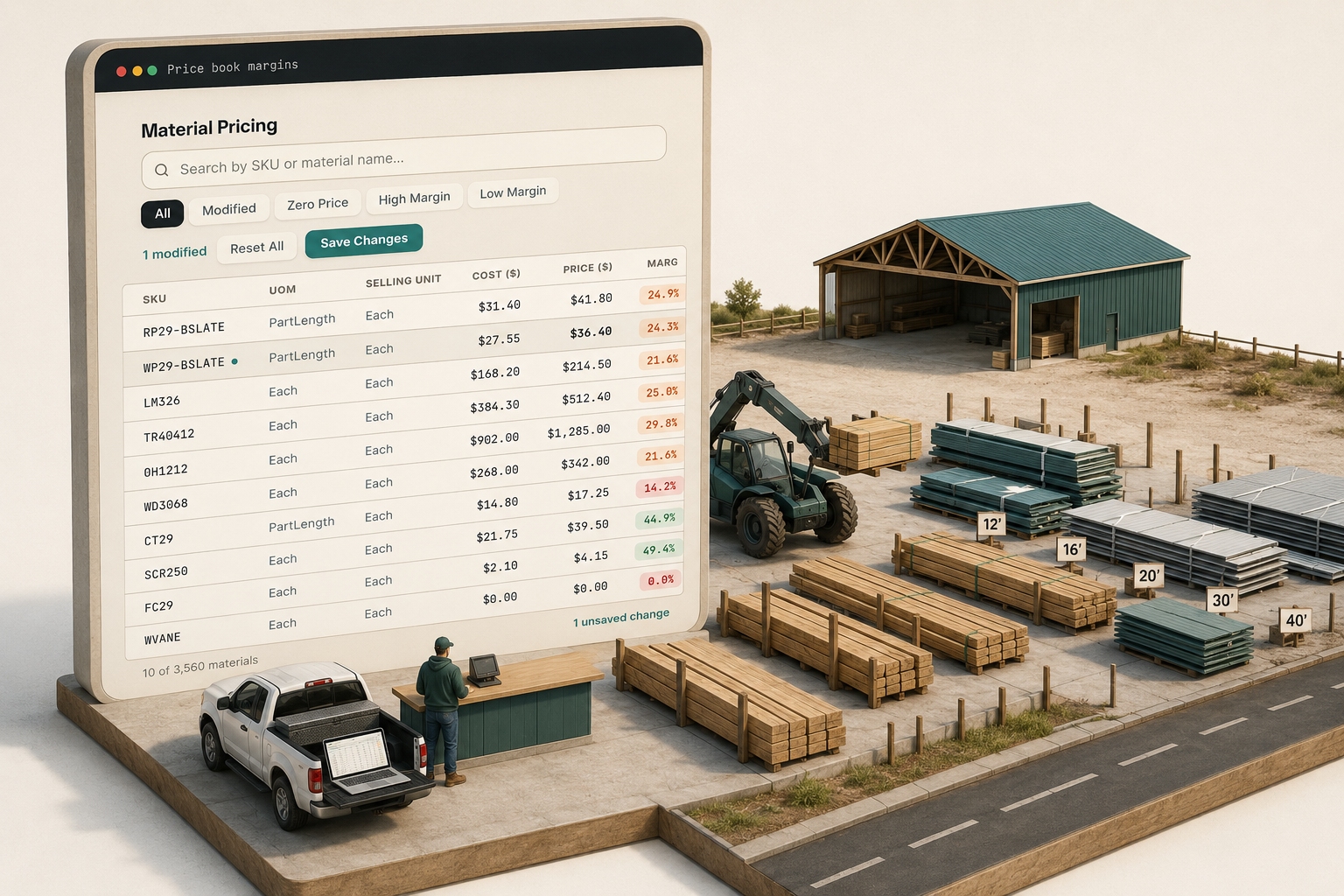
A pole barn cost calculator has one price in it, and it is not yours. It is a per-square-foot rate blended from markets you may not build in, dated to whenever somebody last updated the page. A price book is the opposite object: what your yard charges you for a 2x6 at 16 feet, a 29-gauge panel per foot, a box of screws, per supplier, per unit, and what you sell each of those for. Most of what builders believe about price books comes from having used a calculator first.
Myth 1: "The calculator's rate already includes current material prices"
It includes a material price. Somebody's, from somewhere, at some point. A regional average is an average of yards you do not buy from, in gauges and grades you may not sell, and it moved the day after it was published. When a calculator lands 20–40% off, the material rate hidden inside it is a large part of why. The NAHB publishes framing lumber prices as a running series for a reason: the number does not sit still long enough for an average to hold.
A price book fixes the source, not the average. Every line in the model prices through a material that has a cost you were actually quoted and a sell price you set, per supplier. The 40x60 shop and the 60x100 arena price off the same book, so when the yard moves the 2x6, every building on your bench moves the same morning.
Myth 2: "A price book is a list of what I charge"
That is half a book, and the half that cannot tell you anything. A sell-only list reports revenue. It cannot say whether the steel is carrying the job or the trusses are quietly dragging it, because margin is a relationship between two numbers and you kept one.
The book you want has cost and sell on the same row. In Your material price book, what you pay and what you charge sit side by side, and the book flags zero-priced items, margin under 20% and margin over 40% as you scroll. That is a different thing from the markup you put on a job; row margin is the material's own story, and it is visible before you have quoted anything.
Myth 3: "The takeoff carries the money"
The instinct comes from spreadsheets, where the quantity and the price live in the same cell and one bad paste changes both. In the designer the material takeoff carries a quantity and a unit and nothing else. There is no money on that list.
The money hangs off the material in the book. The panel count is the panel count; what a panel costs is looked up from Your yard's prices behind the model at the moment the estimate is made. That is why a yard price change updates every building at once instead of every estimate one at a time, and why a quantity can be overridden without anyone retyping a price.
Myth 4: "If I update the book, the quotes I already sent will change"
This is the fear that keeps builders from touching their prices mid-season, and it is backwards. While you are drawing, the total follows the book. The moment the estimate is dated and sent, the price is written onto each line and stops following anything.
Put your 2x6 up on Monday and everything still on the bench moves with it. The quote sitting with a buyer since Friday holds the numbers it was sent with, and he keeps reading exactly what you promised him. New designs pick up the new book the next time you finish a building. Where the estimate freezes is the line between the two.
Myth 5: "A price book is a square-foot rate with more rows"
A rate averages the whole building into one unit. A book prices each material in the unit it is actually sold in, and that difference is where quotes go wrong at the yard rather than on the screen. Steel is sold per foot, so a panel line has to carry its length. Lumber is sold per piece at a stock length, so 64 girts have to become 41 sixteen-footers before a yard can price them. Screws are per box; concrete is per yard.
A count in the wrong unit against a rate in the right one produces a number that looks plausible and is not. The book's job is to hold the right unit next to the right price so the multiplication happens the way the yard will do it when the order lands on the counter.
Myth 6: "If my cost is in the system, my customer can see it"
Every row holds two numbers, and every total a customer ever sees is built from the sell price alone. The cost column exists so the margin is in front of you at the moment you type a price; it is on no quote, no portal and no printed estimate. The Your Investment block the customer reads is the sell side of the same book, presented as the building he is buying, and the cost never leaves your side of the screen.
What a price book is, then
A price book is the number the calculator never had: your yard's cost, your sell price, per material, per unit, per supplier, live behind every line of the model until the estimate is dated. The estimate it produces is one you can explain to the buyer row by row, and one you can explain to yourself when the job is over and the margin is either there or it is not.
A construction estimate template is where most builders start, and its limit is exactly this: a template holds prices you typed, a book holds prices the building looks up. When the project manager inherits the number, what he inherits should be the book's answer, not the calculator's.
Checklist for the book this week
- Every material has a cost, not only a sell price
- Costs match the yard's most recent quote, by supplier
- Units match how the yard sells it: per foot, per piece at length, per box, per yard
- Zero-priced rows found and filled
- Rows under 20% margin looked at on purpose
- One sent estimate opened to confirm its prices did not move
One thing the book does not solve: it prices what the model can count. Engineering, the stamp, freight, site grading and permits are not materials, and the takeoff says so in its own not-on-this-list section rather than pretending. Those lines come from the service catalog and from you. How the book sits behind the model, line by line, is on Your yard's prices behind the model, and the book itself is Your material price book.