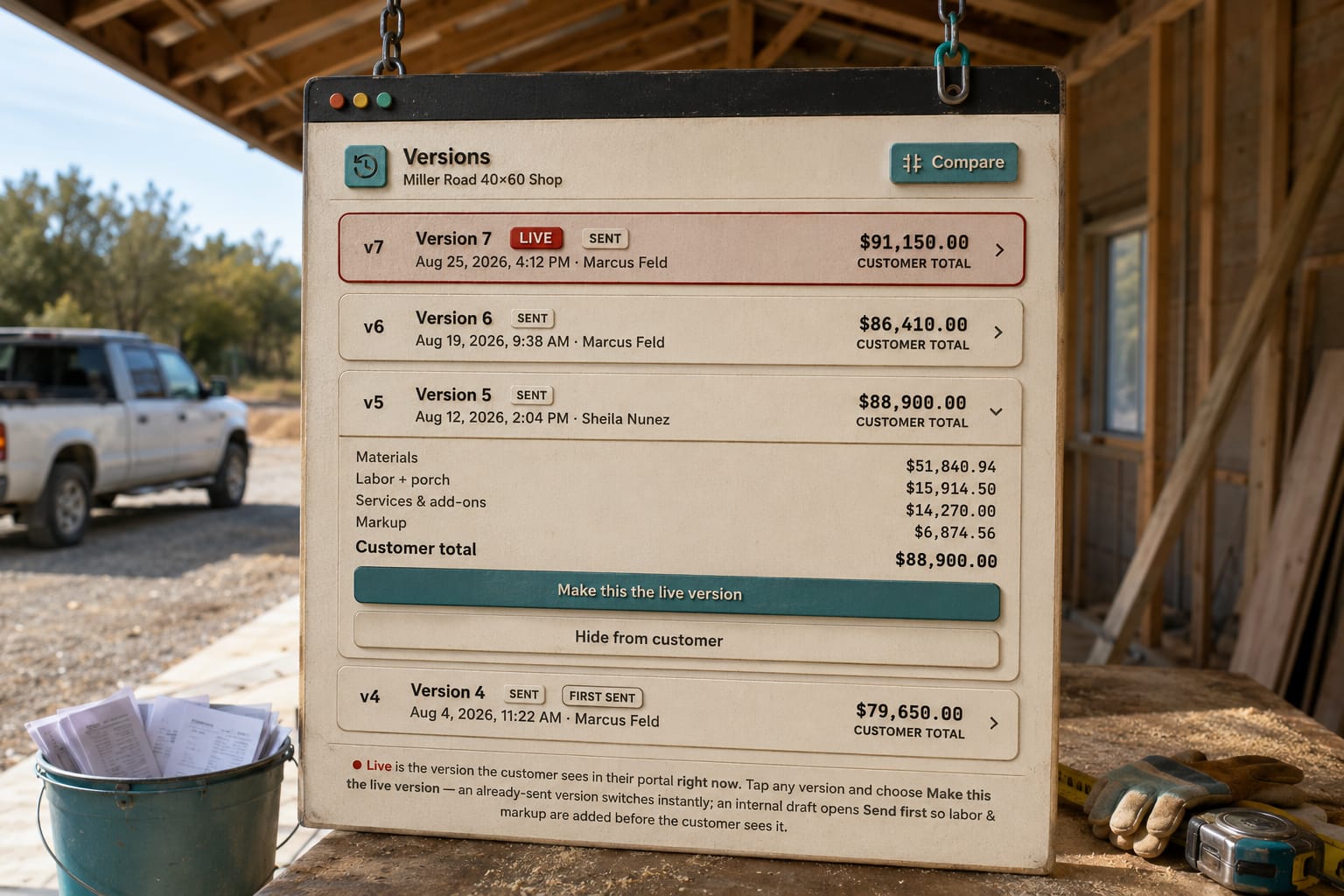
The short answer: Handle barndominium quote revisions on one live link, with each change saved as a dated version behind it, so the customer only ever sees one current estimate. Each version should record what changed (the lean-to, the door moved to the gable end, the wainscot), the new price and the date. The signature and the deposit belong on that same link, beside the price the customer approves.
A revised quote should keep the same link and stack a dated version behind it, so there is exactly one live document at any moment. Estimating software that emails a new PDF for every change hands the customer four documents and leaves the first number — the lowest one — load-bearing in their head. This is what a version record has to capture to be worth keeping, why signing belongs on the same link as the price, and where the deposit fits.
Why does the attachment thread cost real money?
Call it a 40x60x14 shop: 6x6 posts at 8-foot spacing, 60-foot trusses, 2x6 girts, 29-gauge walls and roof, three overhead doors and a walk door, priced at an illustrative $32 a square foot — $76,800. Day three they want a 12x60 open lean-to down the eave. Day six the 12x14 overhead moves from the sidewall to the gable end, which means a different header. Day nine they ask what wainscot costs. That is Miller-Shop-Estimate.pdf, -REV2, -REV2-updated and the one named final that was not, sitting in a thread with a photo of a neighbour's barn and an out-of-office reply.
The damage lands in four places. The customer quotes $76,800 back at you, so every later figure feels like a price rise rather than added building. Your lead carpenter builds off rev 2 and frames the door on the sidewall. When the lean-to surprises them in month two, you have no clean record showing they asked for it on March 4 — the evidence problem a proper change order solves later, only earlier. And you are blind on the one thing that matters: whether they opened it at all. Better file naming fixes none of that. The problem is that you shipped a copy.
What changes when the estimate is a place instead of a file?
One address, sent once; when you revise, the contents change and the address does not. The link they got on day one still works on day nine and shows day nine's price. They can forward it to the spouse who was not on the original email or the banker who wants the number, and everyone reads the same page. Superseded versions stay readable behind the current one, stamped with the dates they were live. And it works on a phone in a truck, which is where the day goes when a PDF needs a computer.
The pain on your side is drawing all week without disturbing the price the customer is looking at. Estimate version history freezes the model and the total into the estimate at send, so the customer's link keeps showing the building he was quoted until you make a new version live.
What has to be in a version record?
Most version control in construction stops at "keep a copy." A version entry is worth keeping only if it answers what changed, who asked for it, and what it did to the price. The shape, on the shop above, with invented figures:
| Version | What changed | Who asked | Total |
|---|---|---|---|
| v1 | Base building, 40x60x14, three OH doors | — | $76,800 |
| v2 | Added 12x60 open lean-to, eave side | Customer, phone, Mar 4 | $84,100 |
| v3 | Added 40" steel wainscot, four sides | Customer, email, Mar 7 | $85,900 |
| v4 | 12x14 OH moved to gable end; header upsized | Site walk, Mar 10 | $86,650 |
Read down that column with the customer on the phone and you are not defending $86,650 against $76,800 — you are showing $9,850 of building they asked for, dated. Nobody argues with their own decisions when they are written next to what they cost. It is also the record that saves you in July when someone asks why the barn cost what it cost; the IRS is blunt in its recordkeeping guidance that records have to actually support the numbers. A proposal that separates scope from price makes that log a running history of scope.
The pain is pricing the wainscot question without the customer watching the number twitch. A draft version lets you move whatever you like and see what it does to the total while the live link does not budge — then you send it, which is what makes it live, or throw it away.
Why does the signature belong on the same link?
Once the price is right, the worst thing you can do is move the customer somewhere else to accept it; every jump — a new email, a login, an app — is a place a week goes missing. Electronic signatures on construction agreements are ordinary under the federal E-SIGN Act and state UETA laws, provided the signer intended to sign, the signature is tied to the exact version, both sides can keep a copy, and the record shows when. Standalone signing tools do this well for a document that has stopped changing; an estimate that moved four times in nine days fights them. Check with your own attorney on what your state and contract type require.
The pain is a customer sitting on the day-three email approving v2 after you sent v4. Only one version is ever live, and if what they approved is not the live one, the job says so on your side before anyone orders a header.
The pain after "yes" is the gap before money: they sign Tuesday, the truck needs brakes, and by Monday they are "getting one more price." The approval block at the end of the quote names the exact total, and the price it approves is the price the contract carries — no step in between where a number is retyped.
Where does the deposit fit?
Two things make a deposit defensible rather than arbitrary. Tie it to what you actually spend first: if the post and truss package lands at $17,000 and you order it the week they sign, a 20% deposit — $17,330 on the example — is the material order, and almost nobody pushes back when you say so in those words. Then name what it buys: "holds your build slot and orders the package" beats "deposit required," and the draw schedule that follows reads as a plan. The whole motion — open the link, read v4, approve v4, pay, land on a page that says what happens next week — is what the live estimate system is built around, and the page your customer reads is where it happens.
Versions stay honest only if each one is counted from the building; our construction estimating software has you draw it in 3D and counts the list while you draw.
What the research says
- The first number sticks. In Tversky and Kahneman's work on judgment under uncertainty, people estimate by adjusting from an initial value, and the adjustment leads to systematic errors. When four PDFs sit in a thread, the first and lowest one keeps working as the anchor; one live estimate with its history behind it leaves only the current number in view.
- Changes are felt as gains and losses from a reference point, and losses weigh more. Kahneman and Tversky's prospect theory shows people value outcomes as changes from where they started, with the curve steeper for losses than for gains. A revision that names what was added ("12x60 lean-to added") gives the customer something he gained to set against the higher price; a new attachment with a bigger total just looks like a loss.
- Barndo and pole building designs change a lot before they settle. Hansen Pole Buildings reports its clients typically request 10 to 15 quotes before finalizing a design (Hansen's own figure for its business, not an industry number). At that volume, a version record is the only way anyone can say which building the customer said yes to.
- What gets signed, and when, matters. California's Contractors State License Board requires a written contract on home improvement work over $500 and signed written change orders before changed work begins. Rules vary by state, but a signature on the same link as the exact version it approves leaves no question about what was agreed.
What versioning does not fix
Versioning keeps everyone on the same page; it does not stop the page going stale. Your steel and truss quote has an expiry, and a v4 the customer sits on for six weeks can be signed at a number you can no longer build for. The honest answer is a validity window on the face of the estimate — 15 or 30 days, matched to your longest supplier quote — and a habit of re-pricing anything older before you countersign. An estimate that revalidates itself against live supplier pricing is a real problem we have not solved. If someone tells you they have, ask what happens when the mill changes its price on a Friday.