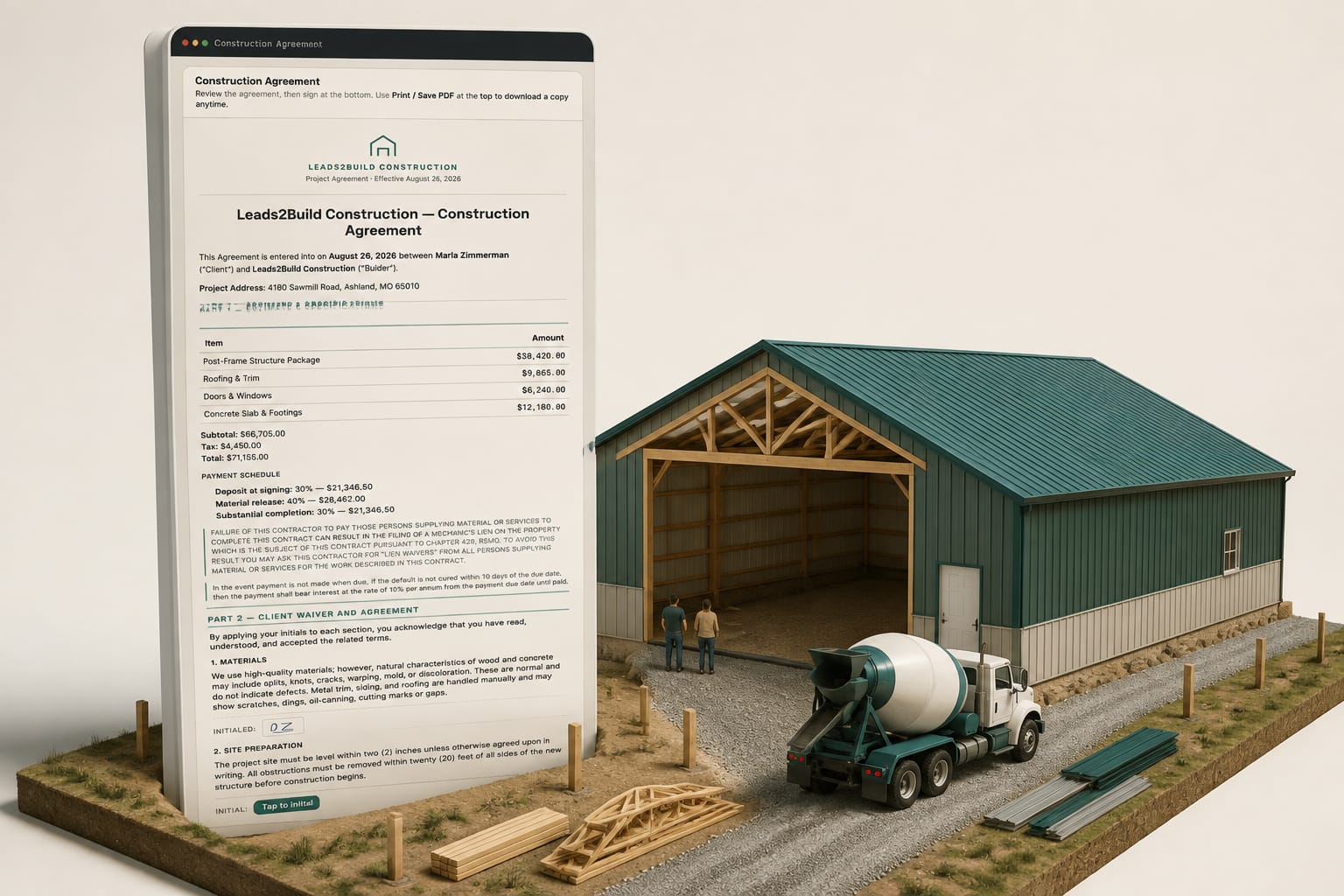
A pole barn contract holds when it settles, in writing, the argument two people are about to have: one walked away from the kitchen table with a slab in the price, the other without. That gap never shows at signing. It shows the morning the concrete crew was due and nobody has agreed who pays.
Almost no builder contract is ever read by a judge. It is read by a homeowner in month three who does not remember agreeing that the overhangs were priced on the eaves and not the gables. So write for the driveway: short sentences, plain nouns, every clause answering one question — when this goes sideways, who decides and who pays?
Here are the twelve clauses that answer it, grouped by what they protect, plus change-order language to lift word for word.
Which three clauses does everything else hang off?
1. Scope of work, written by assembly. Not "erect a 40x60x14 post-frame building." Column size and embedment depth, truss span and on-centre spacing, girt and purlin spacing, panel gauge and profile, which elevations get overhangs and whether they are soffited, doors and windows by size and count, header spans over the openings. The pain is a scope retyped from the estimate and drifting on the way across. When the agreement writes itself from the estimate, the line items, the approved total and the build site land in it untouched, so what was priced is what is described.
2. Exclusions, written as plainly as inclusions. Concrete flatwork. Clearing and grading. Electrical, plumbing, HVAC. Gutters. Insulation and vapor barrier. Permit fees. Stamped drawings. Utility trenching. The slab argument is won here, at the table, not in month three.
3. Allowances and selections, with a date. Every unpicked selection gets a stated allowance and a deadline: "Owner selections due 21 days before scheduled start; delays past that date move the start date and may re-price the material package."
Which four clauses decide whether you get paid on time?
4. Draws tied to milestones, not calendar dates. Tie each draw to a condition anyone standing on the site can verify.
| Draw trigger, verifiable on site | Share |
|---|---|
| Contract signing | 10% |
| Material released to supplier | 30% |
| Columns set and backfilled | 20% |
| Trusses set, roof purlins on | 20% |
| Roof and wall panels complete | 15% |
| Substantial completion, punch list | 5% |
Thirty per cent of the price moves on one fact there, which is why that row is worded as a release and not a delivery date. The pain is a draw schedule that lives in the contract and nowhere else, so invoices get built from memory. When the payment schedule is agreed on the estimate — 30/60/10, four draws, whatever you use — it lands in the agreement as written and the same stages become the invoices. Splitting a price into deposit, draws and final is its own subject.
5. Price validity and material escalation. "Contract price is based on supplier quotes valid through [date]. Beyond that date, documented increases in steel panel and framing lumber cost exceeding 5% pass through at cost, with supplier documentation attached."
6. Late payment, stop work and lien rights. The grace period, the interest rate, and your right to suspend work on written notice.
7. Permits, engineering and inspections. Name who applies, who pays the fee, who pays for engineered truss and column design, and what happens if the building official requires a deeper footing or uplift anchorage the drawings did not carry. The ICC publishes the model codes most jurisdictions adopt, but local amendments bind your job, so name the local authority in the clause.
Which five clauses cover the things that actually go wrong?
8. Change orders. The full clause is below.
9. Weather and unworkable days. Not "delays due to weather." Define it: "Days on which sustained winds exceed 25 mph during truss setting, precipitation prevents panel installation, or soil conditions prevent equipment access extend the schedule day for day, without penalty." Then hold to your own definition — the discipline behind a schedule that survives weather.
10. Site access, laydown and utilities. The requirement with its consequence: unobstructed access for a 48-foot delivery trailer, failed deliveries billed at the supplier's re-delivery rate plus crew standby.
11. Owner-supplied work and site condition. An owner-hired concrete contractor, an uncle doing the electrical. Say who owns slab elevation, flatness and squareness, and who confirms location and setbacks.
12. Warranty, termination and where a fight goes. A start date (substantial completion, not final payment), a length, an exclusion list, a written-notice requirement, then the dispute sequence — notice, site meeting, mediation — and whose law applies.
What does the change-order clause say?
Changes to the Work. No change to the scope, materials, or schedule is authorized until a written Change Order describing the change, the adjustment to the Contract Price, and the adjustment to the completion date is signed by both parties. Verbal instructions, text messages, and site conversations do not authorize a change. Contractor may decline to proceed with changed work until the Change Order is signed. Where a change affects work already installed, the Change Order price shall include removal and rework. Where a change affects material already released to the supplier, Owner shall pay any restocking, cancellation, or price-difference charge, with supplier documentation attached. Approved Change Orders are due with the next scheduled draw.
"Signed by both parties" kills the verbal change. "May decline to proceed" is the sentence with teeth — without it you argue price after the work is installed. "Due with the next scheduled draw" keeps changes out of the final-payment fight, the point of the change order that protects your margin. The pain is the photocopied form on the truck dash with a number, a signature and nothing else. A change order raised against the job carries that change's price, the revised contract total and the days it adds, and freezes at signature.

Have a lawyer in your state read that paragraph first. It is a starting point, not legal advice.
Which notices does your state add to the contract?
The clause that most often goes missing is the one your state already wrote for you. Lien notice wording, a right of cancellation on residential work, a delivered paper copy, a disclosure that must sit above the signature line — statutory, nowhere near uniform, and attached to the state the building goes up in, not the state your office sits in. The pain is one template carrying your home state's notice onto a job two counties over. A contract library written for how you actually build picks the governing-law and lien block off the build site's state: Missouri and Kansas have their own statutory wording, elsewhere it names the state and its lien rights generally. The obligation follows the land, not the letterhead.
Signing itself is the part people over-think. Electronic signatures are enforceable under the federal E-SIGN Act and, in nearly every state, UETA, and what survives a challenge is its own post. What matters here is the version: the customer signs the agreement they actually read, exhibits inside the same document, and the signed copy sits on the link they already have.
What should you check before you send the next one?
- Read the Exclusions list out loud, at the table, before anybody signs.
- Confirm every draw trigger is something you could photograph.
- Check the notice and lien language matches where the building is going up.
- Give every allowance a date, not a promise.
- Make sure the change-order clause says may decline to proceed.
One honest limit: a contract collects nothing. If a customer stops paying, what protects you is your state's mechanic's lien process, and that runs on deadlines ticking from first delivery or first labor, not from the day you get worried. We do not track those deadlines for you yet. Put them on a calendar the day material is released, and treat them like the draw schedule.