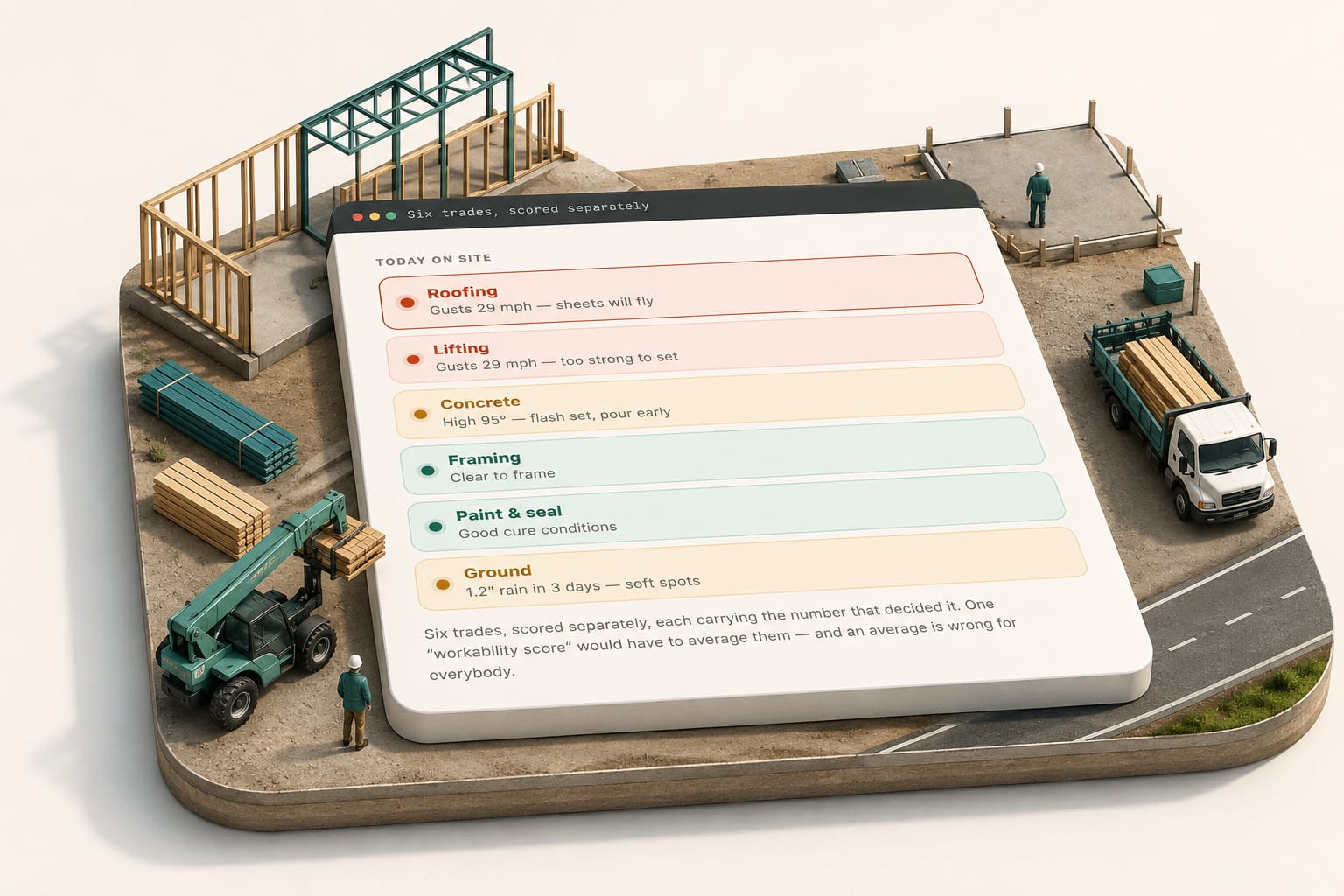
Every builder has had the same week. The construction schedule you built in January said post set on Tuesday, sheeting Thursday, done by the fifteenth. Then it rained for six days, the concrete truck got rebooked, the crew you were holding took another job to fill the gap, and by the time the ground dried you were three weeks out — not six days, three weeks. The customer, who has been reading the schedule you emailed them in January, wants to know what happened.
The rain wasn't the problem. The schedule was. It was built as a list of dates, and dates are the one thing an outdoor build cannot promise.
Here's a way to build a construction schedule that bends instead of breaking — and, more importantly, that keeps the customer on your side when it does.
Why builder schedules fail
Three things break a schedule, and only one of them is weather.
Dependencies nobody wrote down. You can't set posts on a slab that hasn't cured. You can't sheet a roof that isn't trussed. Every builder knows the sequence cold, which is exactly why it never makes it onto paper — and why the schedule can't tell you what a lost Tuesday actually costs. When the sequence lives only in your head, a delay looks like one day, and it's really five.
Weather, which is not a surprise. Rain in April is not an unforeseeable event; it's a Tuesday. Yet most schedules are built as though every day between now and completion is workable, which quietly turns your schedule into a best-case scenario that gets presented to the customer as a promise.
Verbal updates. The schedule changed on Wednesday. The crew knows because they were standing there. The office knows by Friday. The customer knows when they call. Every one of those gaps is a place where trust leaks out — and the customer's version of events is always the last one to get updated.
The uncomfortable part: your dates were probably fine. The way they were structured, held, and communicated is what failed.
Stage-based scheduling beats date-based scheduling
A date-based schedule says "post set: April 14." A stage-based schedule says "post set: 2 days, starts when the slab has cured 7 days, requires the crew and the delivery."
The difference shows up the moment something moves. A date-based schedule breaks — every downstream date is now wrong and someone has to retype them. A stage-based schedule recalculates: the slab slipped four days, so post set starts four days later, and everything behind it moves with it. You didn't reschedule the job; you moved one thing and the job rescheduled itself.
That's the whole idea. Stages, durations, and dependencies are facts about the building. Dates are just what those facts compute to on a particular Monday.
Here's a typical post-frame sequence expressed that way:
| Stage | Duration | Waits on | Weather-sensitive |
|---|---|---|---|
| Permits & engineering | 1–4 weeks | Signed contract, deposit | No |
| Site prep & excavation | 1–3 days | Permit, dry ground | Yes |
| Concrete / slab | 1–2 days + cure | Site prep | Yes |
| Material delivery | 1 day | Confirmed order, site access | Partly |
| Post set | 2–4 days | Cure, delivery, crew | Yes |
| Trusses & framing | 2–5 days | Post set, crane or lift | Yes |
| Roof & wall steel | 3–6 days | Framing complete | Yes — wind, not just rain |
| Doors, trim, finish | 2–4 days | Steel, door delivery | Mostly no |
| Walkthrough & final invoice | 1 day | Punch list clear | No |
Notice how much of the build is weather-exposed, and notice where it isn't. Permits, orders, and door lead times are the stages you can bank in bad weather — which is exactly the insight that saves a lost week, if your schedule is honest enough to show it.
Notice something else: seven of those nine stages wait on something. That's why a one-day delay is never one day.
How to size a buffer without padding the quote
Most builders handle weather one of two ways: pad every stage a little (which inflates the whole schedule and eventually the price), or promise the best case and apologize later. There's a third option that's better than both.
Put the buffer at the stage level, sized to exposure, and hold it as a pool. Concrete and steel get real weather float. Permits and finish work get almost none. Then, instead of quoting the padded total as your promise, quote the range — and tell the customer where the range comes from.
Three rules make this work:
- Buffer the exposed stages, not the schedule. A blanket 20% on everything is a tax on the stages that never slip.
- Use your own history, not a rule of thumb. If you've been logging why days were lost, you already know your real weather-loss rate for April in your county. That number is worth more than any industry average — and if you're not logging it yet, start now; a year from today you'll be quoting from evidence.
- Never spend the buffer silently. A buffer that gets consumed without anyone noticing is just optimism with extra steps. When it's gone, that's a signal, and it should be visible before the customer discovers it.
Local climate history is genuinely useful here — NOAA's Climate Data Online in the US and Environment Canada's historical data in Canada will tell you the average number of wet days for your month and location, for free. Start there, then correct with your own logs.
The reschedule conversation, and how to stop having it
A customer who finds out about a delay from a schedule they can see is annoyed for a minute. A customer who finds out by calling you is suspicious for the rest of the build. Same delay. Completely different relationship.
So the fix isn't better delay-explaining. It's making the schedule something the customer can watch rather than something you have to report. When a stage moves, they see it move, with the reason attached — "weather hold, 2 days" reads very differently from a silent slip that they eventually notice on their own.
This is why a branded customer portal earns its keep on long builds: the update isn't a task you have to remember on your worst week, it's a byproduct of updating the schedule you were updating anyway. The weeks you're too busy to send updates are precisely the weeks customers most want them.
Two things to say out loud at contract signing, before anything has gone wrong:
- "Weather days move the schedule; they don't change the price." Set that expectation early and a rain week costs you time instead of an argument.
- "You'll see every change as it happens, and why." Then deliver on it. This one promise prevents more nervous phone calls than any amount of after-the-fact explanation.
What to log when you lose a day
A lost day is data if you write down why, and a shrug if you don't. Log four things, on the day, from the field:
- The date and which stage it hit
- The reason — weather, materials, crew, equipment, permits, or access
- Whether it moved the finish date or just ate buffer
- A photo, if the ground or the sky is the argument
Do that for one season and you get answers to questions you currently guess at: which month actually costs you, whether your supplier's lead times match what they promise, whether "weather" is really weather or a crew allocation problem wearing a raincoat. That's the raw material for quoting the next job accurately — and, if a completion date is ever disputed, it's the record that settles it.
What to look for in scheduling tools
Generic project tools — boards, spreadsheets, shared calendars — are flexible and cheap, and plenty of builders run real jobs on them. They're worth keeping if they're working. The place they run out of road is specific: they don't know what a build is, so the dependency logic, the weather reasons, and the money all stay in your head.
If you're evaluating something purpose-built, four questions separate a real construction schedule from a prettier calendar:
- Does moving one stage move everything behind it? If you're retyping dates, the tool doesn't understand dependencies.
- Can a delay carry a reason? Weather, materials, crew — and can you report on those reasons later?
- Does the customer see it without you sending anything?
- Is it connected to the money? Stages are when deposits, draws, and progress invoices come due. A schedule that doesn't know about billing means someone reconciles two systems by hand every month.
That last one is where most tool stacks quietly break down, and it's the reason we built scheduling into the same system as the estimate, the contract, and the invoice rather than beside it. When the stages that run the build are the same stages that trigger the billing, "where are we?" and "what are we owed?" stop being separate questions. Here's how that whole flow runs, lead to paid.
Stage-based, not date-based, is the short version of that list. A build schedule keyed to stages moves the work that genuinely depends on a lost day and leaves the rest alone — and checkpoints record why the day was lost while somebody still remembers.
The part nobody schedules
Here's the honest open loop. Even a perfect schedule assumes the job you scheduled is the job you're building — and it usually isn't. The customer adds a lean-to in week two. The door size changes. Someone says "while you're here."
Every one of those changes moves the schedule and the money, and the second one is where post-frame margin actually disappears. Scheduling the change is the easy half; pricing it, getting it signed, and getting it billed before the final invoice is the half that pays for the year.
That's its own playbook, and it's the next one we're writing.
If you're still deciding what your estimating side should look like before you get to scheduling at all, start with the honest fit guide to pole barn estimating software — it covers the same evaluate-the-fit approach for the front half of the job. And for standards, engineering references, and the trade's own body of knowledge, the National Frame Building Association is the place to start.