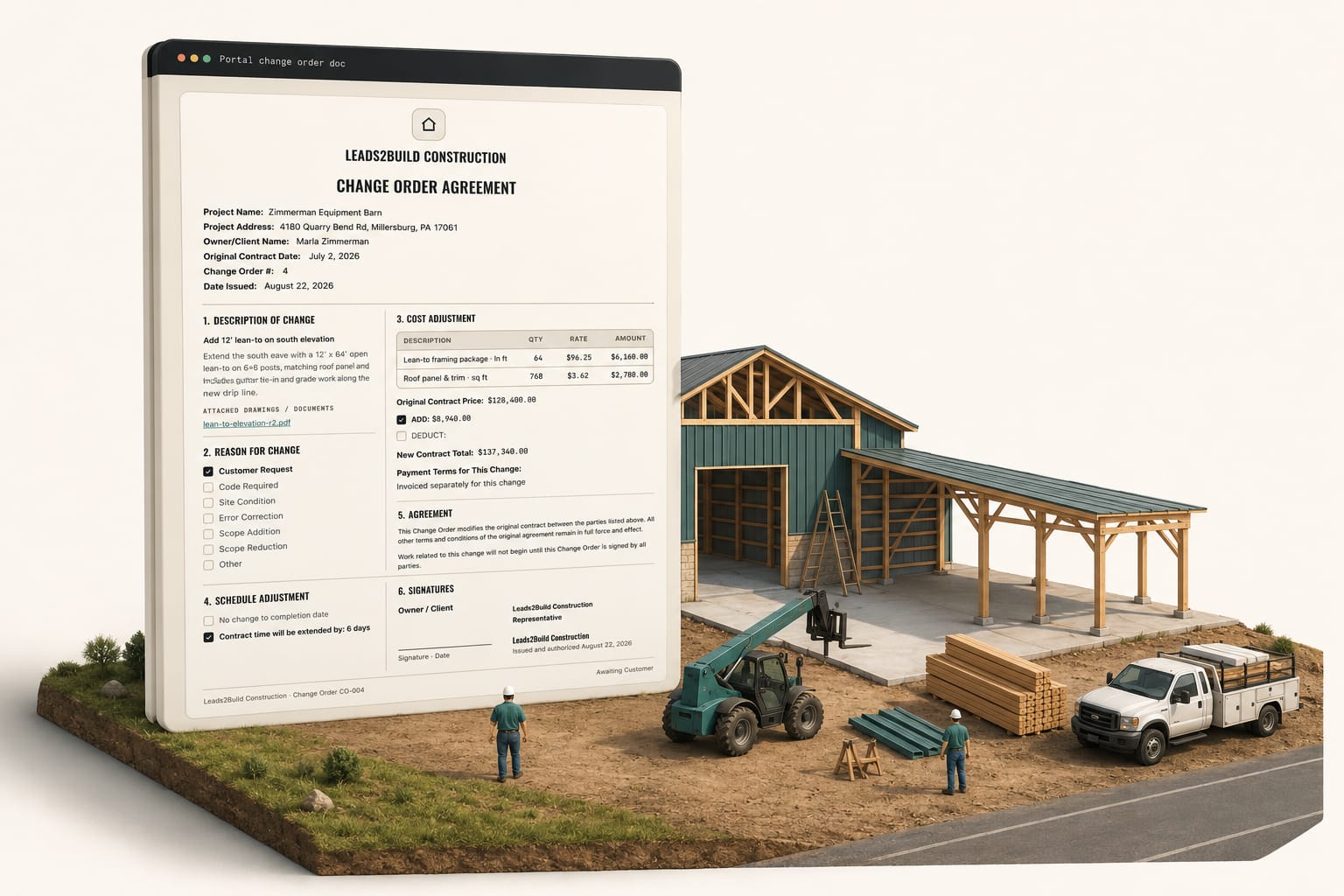
Ask a post-frame builder where the money went on a job that came in under margin, and the answer is almost never the estimate. It's the four things that got added after the contract was signed, agreed in the yard, never written down, and quietly absorbed.
A construction change order is the document that stops that. Here's what has to be on one, when to issue it, and how to have the conversation without souring a job you're standing in the middle of.
Why verbal change orders are so expensive
The cost isn't only the material. It's four costs stacked:
- The work itself — the lean-to, the extra door, the upgraded steel.
- The schedule — the stage it pushes, and everything behind it. A two-day add in week three is rarely two days.
- The argument — at final invoice, when the customer's memory of "while you're here" and yours have diverged.
- The relationship — because that argument happens at the exact moment you wanted a referral.
None of these appear on any report. That's precisely why the habit survives: the expensive part is invisible until the job is over.
Here's the honest bit, and every builder knows it: the verbal change order exists because it keeps the job moving. The customer is standing there, the crew is waiting, and stopping to write a document feels like bureaucracy. The fix isn't discipline — it's making the document take ninety seconds.
The five parts of a change order that holds
1. What changed, in one sentence. "Add one 10×10 insulated overhead door to the east wall." Not "door change." A sentence a stranger could act on.
2. What it costs, broken out. Materials, labour, equipment, and your normal margin — as separate numbers. A lump sum invites negotiation; itemised numbers invite acceptance.
3. What it does to the schedule. "Adds 1 day to framing; completion moves from May 12 to May 13." Say it even when it's zero. Especially when it's zero — that's a gift you should get credit for.
4. What it does to the payment schedule. Which draw it lands on, or whether it's billed on completion — construction invoicing software that bills in draws is what carries that change onto the right bill.
5. Two signatures and a date. Yours and theirs. Before the work happens.
That's the whole document. One page. If it takes longer than the conversation that produced it, it won't get used.
Timing: the ninety-second rule
The change order should be signed before the work is done, on the day it's agreed. Not at the end of the week. Not "I'll write it up tonight."
Two reasons, both practical. First, memory: at the moment of agreement the customer knows exactly what they asked for and is expecting it to cost something. Twenty-four hours later, it has become a favour they think they were promised. Second, leverage — and this cuts your way: the honest builder loses more from delay than the customer does, because the work gets done either way and only the paperwork is missing.
This is why change orders are the one document worth being able to produce from your phone, standing in the mud, with the customer next to you.
How to say it without souring the job
The wording matters more than the form. Three sentences that work:
"Happy to do that — let me price it before we start so there's no surprise on your final bill."
That frames the document as protection for them, which it genuinely is.
"It's about $1,400 and adds a day. Want me to send it over now?"
A number and a consequence, immediately. No ambiguity to resent later.
"I'll text you the change order — sign it on your phone and we'll get it in this week."
The friction is the enemy. If signing means printing, it will not happen today.
What to refuse
Not every change deserves a change order. Some deserve a no.
- Changes that compromise the structure. A customer asking for a truss modification is asking you to take on engineering liability. That's a conversation with the truss supplier, not a change order.
- Changes during the wrong stage. Moving a door after the steel is on isn't a change, it's a rebuild. Price it as one, or decline.
- Accumulated small favours. Three "while you're heres" is a change order, not three acts of goodwill. Bundle them, price them, and send one document.
When the paperwork becomes the system
A pad of carbon forms in the truck genuinely works. It has one flaw: the signed page lives in the truck, then a filing cabinet, and the office finds out at final invoice — which is exactly the failure mode you bought the form to prevent.
What actually closes the loop is the change order being the same object as the price, the schedule and the bill. Ours is priced from the estimate it amends, signed on a phone, and once signed it moves the completion date and adds its own line to the invoice automatically — so nobody has to remember to tell anyone. Here's the whole path, and the customer's side of it is where they see the change reflected without calling you.
That is the whole argument for making it a system rather than a habit: change orders that carry their own signature, price and schedule impact reach the invoice and the build schedule on their own, which is the half that verbal agreements always lose.
The one-week test
For the next week, write a change order for every single addition — even the ten-dollar ones, even the favours. At the end of the week, add up the column.
Most builders doing this for the first time find a number between $2,000 and $8,000 on a single job. That number was always there. It just never had a document to land on.
Before you write your own form, it's worth reading how the industry standardises them — AIA's change order documents are the reference most contracts point at, and the National Frame Building Association carries the post-frame-specific material.
And once the change order is signed, it has to reach the schedule and the invoice or you've only solved half of it — the schedule side is here, and the invoice side here.