A third tab in payroll progression, beside People and Positions, which move pay inside a position; a career path moves people between positions. A career path is positions in order. Each step up carries the milestones that earn it, counted from the day someone took the position below: approved hours, jobs finished, crew surplus, commission or sales, time with the company, no strikes in N days, and skills a manager signs off ("reads a plan set and lays out the posts", "ran the crew for a week with the lead away"). Each position says what it pays, and its own raise path holds the raises inside it. The line is drawn compact and wraps, so a long path fits on one screen. Everyone whose position is on the path shows their progress to the next step, with Promote when they're ready. Every position change is recorded, and past promotions can be entered, so the tab can say what it actually took the people who were promoted, beside what the path asks. Built exclusively for post-frame and barndominium builders, where the best lead you'll ever have is usually on your crew already.
Also called: career ladder · career path for construction workers · crew lead promotion · how to become a project manager · sales rep to sales manager · promotion criteria · career progression · job ladder · employee retention construction · career development plan
The road from here, written down
The field path at Ridgeline: crew member, then crew lead at 2,000 hours, 20 jobs, 90 days without a strike and two sign-offs (reads a plan set and lays out the posts; ran the crew for a week with the lead away), then project manager at 24 months as a lead, 40 jobs, 180 clean days and two more sign-offs. Each position says what it pays. Big nodes are positions, the small ones before each are what earns it, and a long path wraps rather than scrolling. Below it, What it actually took: the four crew members who made lead took a median of about 18 months and 2,980 hours, against the 2,000 the path asks. The owner sees his bar is a little low, or that it takes longer than he thought, from his own records. Every promotion is recorded from the day you start, and past ones can be entered so the numbers start now.
Promotions decided by feel give nobody a target, and leave the owner no way to check the bar he set.
Specific goals beat vague ones, and the data the system collects on its own keeps the milestones honest.
How close am I?
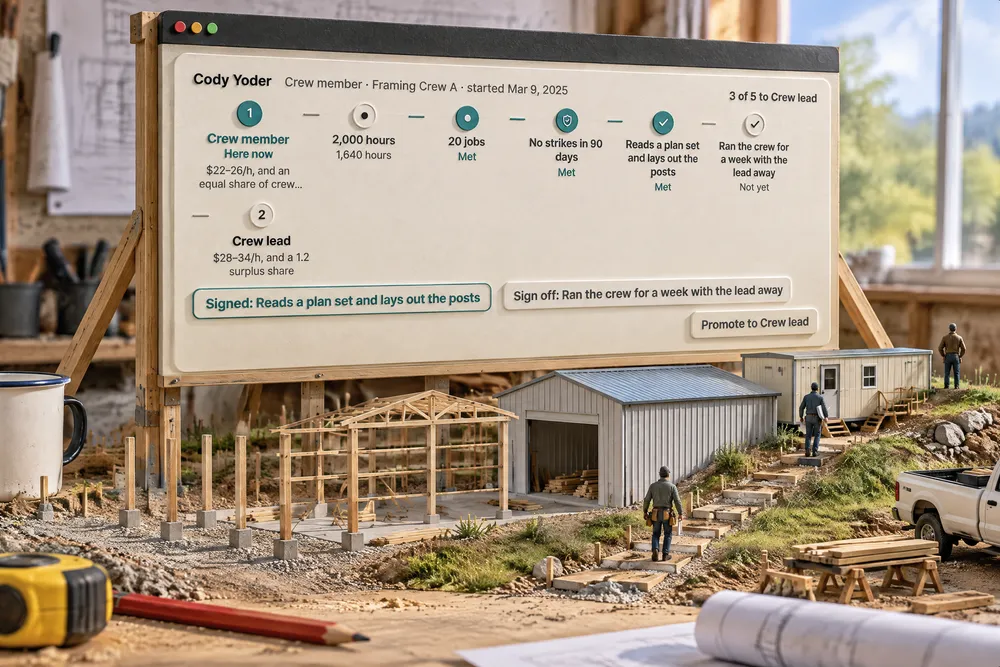
Cody Yoder has been on Framing Crew A since March 2025. His row shows 3 of 5 to Crew lead: 22 jobs finished, 204 days without a strike, and the plan-set sign-off are met, and he has 1,640 of the 2,000 hours and one sign-off still to go. Milestones count from the day he took his current position: approved hours, jobs his crew finished, days since his last strike. A sign-off is a manager's click. When every milestone is met the next position turns amber and Promote to Crew lead is the obvious next step. Promote changes his position and records the day, and his pay is set on purpose, on his profile or the crew lead journey. A man who can see he's 360 hours from crew lead has a reason to stay for them.
Nobody on the crew knows how close they are, so nobody pushes for it.
Progress you can see toward a goal you can measure is what makes people push, and promoting from inside beats hiring from outside.
- 1Open Accounting → Payroll → Progression → Career paths. Each position shows the path it's on, or Map a path.
- 2Start from a ready-made path (Field, Sales, Office) or a blank one. Every number is yours to change.
- 3In the editor, add positions in order. On each step up, add milestones: A number reached (hours, jobs, surplus, commission, sales, days or months), A clean record (no strikes in N days) or A manager signs off.
- 4Open a path to see its line, everyone on it with how far they are, the Sign off buttons for skills and Promote to … when they're ready.
- 5Promote changes the person's position and records the day. Their pay doesn't change by itself: set it on their pay profile or the new position's journey.
- 6What it actually took shows, for each step up, the median months, hours worked, jobs finished, surplus jobs, crew surplus and strikes of the people promoted, beside what the path asks. Record a past promotion adds the ones from before.
Ask a crew member what it takes to make crew lead at most builders and the honest answer is "when the owner decides". That isn't a goal anyone can work toward. A path with the positions in order, what each one pays and exactly what earns it is. Specific goals with progress shown beat "keep working hard", and people who were promoted from inside outperformed outside hires for two years and left less, while outside hires cost about 18% more. It matters most in the trades. In the 2026 AGC and NCCER workforce survey, 87% of contractors had craft positions open, half said applicants weren't qualified, and 83% lost some new field hires in their first 90 days. In Gallup's survey, most people who quit said it was preventable, and half said nobody had talked to them about their future in the three months before. A path is that conversation, written down. Two things keep it honest. The best seller isn't reliably the best manager: top sales performance raised the odds of promotion and was linked to sales declines afterwards. So a path can ask for coaching sign-offs, not just numbers. And an owner who sets the bar for crew lead from a gut feeling has nothing to check it against, so every promotion is recorded and the tab shows what it really took. Even a builder who never maps a path collects that data just by using payroll for a few years.
- Promotions decided by gut feeling, with nothing written down
- Nobody on the crew knowing what earns the next position
- Good people leaving for lack of a visible future
- Milestones set without data to check them against