Strikes connect employee reporting to the raise paths in payroll. Anyone on the team can report anyone — the crew from Report someone in their field app, the office from the card on Home. A manager reads the report on the person's record and files it (it happened) or declines it with the reason. Only a filed concern is a strike: a declined report never is, and neither is praise. Each raise path carries its own rules, each one a sentence — every strike, or every 2nd or 3rd, within a number of days or at any time, for one kind of report or any → pause progression for a number of days, restart the current line, or forfeit the next reward. On People, the person's row shows how many strikes they have and Paused until while a pause runs. Built exclusively for post-frame and barndominium builders, where a man with no harness on a truss set is a different thing from a late Monday.
Also called: strikes · employee strikes · strike policy · write-up policy · progressive discipline · pause a raise · raise path pause · safety strike · attendance strike · forfeit a bonus
Each path says what a strike does
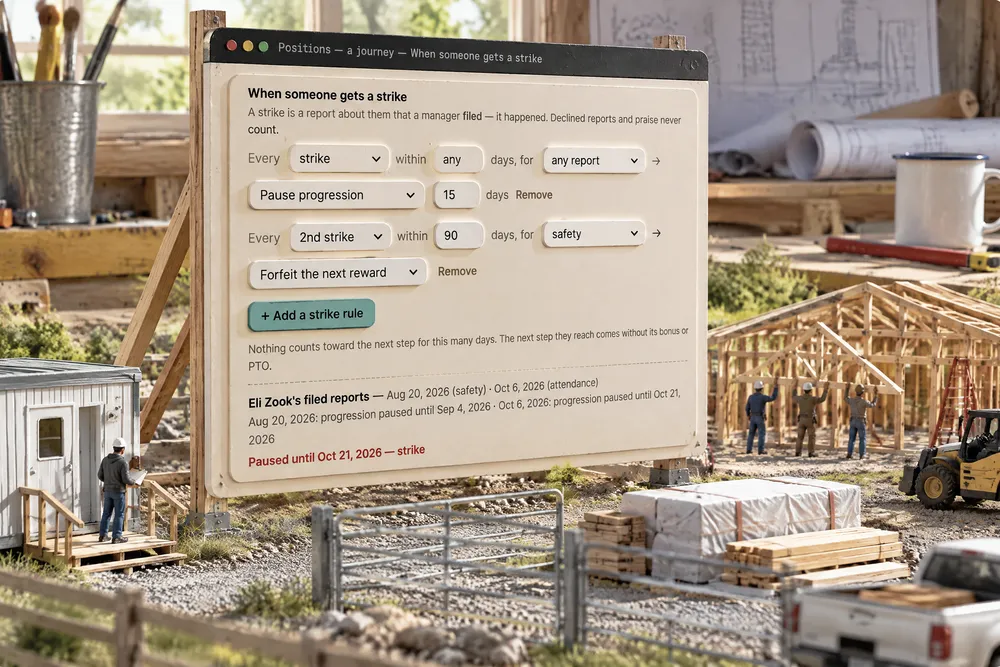
Try itOpen a path in Positions and set When someone gets a strike. A rule reads as a sentence: Every strike — or every 2nd, 3rd, 4th or 5th — within a number of days (or any time), for one kind of report (attendance, performance, conduct, safety, other) or any, → Pause progression for a number of days, Restart the current line, or Forfeit the next reward. A path can carry several. Ridgeline's crew path pauses 15 days for any strike and takes the next bonus or PTO for a second safety strike within 90 days. Change a rule and the line under it shows what Eli Zook's two filed reports would do.
One policy for everything either lets a repeated safety lapse slide or hits a man for one late morning as hard as for walking a roof with no harness.
A consequence written down before anything happens is one the crew can see coming. Nobody decides it in the moment, the same lapse costs everyone the same, and a crew that knows a safety strike costs something takes the harness seriously.
Only a filed report is a strike
Try itReports come from Report someone in the crew's field app and from the card on Home in the office — see employee reporting. On the person's record a manager files a report when it happened, or declines it with the reason. Only a filed concern counts: file Dale's report that Eli was late on Oct 6 and Eli's row picks up 1 strike and Paused until Oct 21, 2026; decline it and his path keeps counting — 19 days to go. Good work is filed too, and never counts.
If every report counted, one grudge on the crew could hold a man's raise back.
A strike that only counts once a manager has looked at it is one the crew trusts, and that is what keeps people using the report button — for problems and for good work.
Paused until — on the person's row
Try itOn Accounting → Payroll → Progression → People, a person with strikes carries a strike badge, and while a pause runs the row says Paused until and the date. Days, hours, jobs and sales inside the pause don't count toward the next step, so Eli's 60-day line stands at 36 days of 60 instead of 41. Open the row for each strike's date and type.
A pause nobody can see is a raise that quietly doesn't come — and a question at the truck every Friday.
Showing the pause and the day it ends means nobody has to ask why a step hasn't come, and a man can see exactly when he's counting again.
- 1A crew member reports from Report someone in the field app; the office reports from the card on Home. Both land on the person's record, where only managers see them.
- 2A manager files the report if it happened, or declines it with the reason. Reopen undoes either.
- 3Only a filed concern counts as a strike. A declined report and Good work never do.
- 4In Accounting → Payroll → Progression → Positions, open a path and set When someone gets a strike: every Nth strike, within N days, for one report type or any → Pause progression, Restart the current line or Forfeit the next reward.
- 5A path can carry several rules — a 15-day pause for any strike, and the next reward forfeited for a second safety strike within 90 days. Each path keeps its own, so the crew path and the sales path can differ.
- 6People shows the strike count on the person's row and Paused until with the date; opening the row lists each strike's date and type.
- 7While a pause runs, nothing counts toward the next step — not days, not hours, not jobs, not sales. When it ends, counting picks up where it stopped.
Every builder has a write-up policy. Most of them live in the owner's head, which means the same late morning costs one man nothing and another man his raise, depending on the week. And a raise path that pays out on schedule no matter what tells the crew a safety lapse doesn't matter. So the consequence is written into the path, before anything happens: what one strike does, what a second safety strike inside 90 days does. The crew can see it, and nobody decides it in the heat of the moment. Two rules keep it trusted. A report only becomes a strike once a manager has looked at it and filed it — one grudge on the crew can't hold anyone's raise back, and a report that turns out wrong is declined with the reason on the record. And praise sits on the same list and never counts against anyone, so the report button is something people use for good work too. Why a count works better than a write-up in a drawer: the certainty of a consequence deters far more reliably than its size. A strike everyone can see, that every filed report adds to, with what it does written down in advance, is certain. Strike conduct someone saw, never a job that simply ran over: a crew with no surplus may have been handed a budget nobody could beat, and a routine penalty for outcomes becomes the price of a slow job. Word the rules as guidance you may apply rather than a promise of exact steps, and never strike pay talk, a group complaint or an injury report. When the crew is beating its figure, a lower surplus multiplier is the other lever: the share the man didn't earn goes to the men who carried him.
- Write-ups that change nothing about a man's pay
- A strike policy that depends on the owner's mood that week
- Reports counted against someone before anyone checked them
- No way to treat a safety lapse differently from a late start
- Nobody able to say when a paused raise starts counting again