Most builders have exactly one lever for their people: the raise, handed out when somebody asks for it. Then they wonder why the raise didn't make anyone work harder, why the best framer still left for two dollars an hour down the road, and why the crew that finished early last month left a punch list nobody wants to look at.
The raise did what a raise does. It just wasn't the lever for any of those problems.
Every reward you can give buys a different behavior. A raise buys staying. A bonus buys a push toward a finish line. A share of what the crew saves buys speed, and on its own it can buy shortcuts too. A title buys pride for almost nothing. A career path buys aim. A strike buys fewer repeats. Match the lever to the behavior you want and the money starts working. Mismatch them and you pay for something you didn't need.
This is the construction incentive program we'd build for a post-frame or barndominium crew: what each lever drives, why people respond to it, where it goes wrong, and the research behind every claim. It matters more in our trade than most. In the 2026 AGC and NCCER workforce survey, 87% of contractors had craft positions open, half said the people applying weren't qualified, and 83% lost some new field hires inside their first 90 days. Keeping good people, and getting the most from them, is the business.
One honest note first. A 2022 review of 1,568 economics estimates (a preprint, not yet peer reviewed) found that once you correct for which results get published, money incentives in field experiments do far less on average than the headlines suggest. Incentives work when three things are true: the person can actually move the number, they believe the target is reachable, and the payout is clearly tied to it. That's expectancy theory, and almost every failure below breaks one of those three.
The short version: problem → lever
| The problem on your jobs | Reach for | Why |
|---|---|---|
| Jobs keep running over the labor budget | A shared surplus, beatable figured days, a bigger share for the lead who sets the pace | Small-crew team pay works through peer pressure; nothing works if the target can't be beaten |
| One guy drags the whole crew down | Lower his share of the surplus, from filed reports | The men carrying him keep what he didn't earn |
| The crew cuts corners to finish fast | Photo checkpoints on every stage that gets covered up, strikes for rework | Pay for speed pulls effort off quality unless quality is measured too |
| Problems show up months after the job | Trace it to the job and crew, then add a checkpoint | Speed pay worked at Safelite because defects were traceable |
| Your best people get poached | A raise, with a title on the same step | Pay growth keeps high performers; status doesn't fade |
| New hires quit in the first few weeks | Several small bonuses at 30, 60 and 90 days, a first title fast | Effort speeds up as a goal gets close |
| Good people leave because they see no future | A career path with the next position, what it pays and exactly what earns it | Internal promotion beats outside hiring |
| Someone keeps slipping on a job with no surplus | Strikes that pause progress toward their next step | Losing progress hurts more than gaining it pleases |
| Sales are flat | Commission raise for proven closers, a quarterly pacer for the rest | Different reps respond to different structures |
The rest of this article is the why.
Crew labor: the shared surplus, and the multiplier that cuts both ways
Pay a crew straight hourly on a shop you figured for seven days, and every day they save is a day's wages they don't get. Nobody on your crew is lazy for noticing that. The fix most builders land on is a share of what the crew saves: the job is figured for a number of days, the labor budget is those days at what the crew costs, every hour is still paid, and whatever's left when the job is done is the crew's to share. Hourly pay with a shared surplus shows how it works, including what happens on the job that runs over.
Team pay like this has strong evidence behind it, as long as the team is small enough to see each other work. Continental Airlines' company-wide bonus worked through mutual monitoring inside small work groups. A retail chain's team bonus raised sales 3% and returned $2.10 of profit for every bonus dollar. Moving a garment plant to team piece rates raised productivity 14%, and the best workers joined teams first. In a field experiment, team incentives lifted output 9 to 17%, mostly through guilt and social pressure: nobody wants to be the one who cost the crew its share. A three- or four-man framing crew is about the best place on earth for that to work.
Turning the multiplier up: a bigger slice, not a bigger pie
Not every hour on a crew is worth the same to the result. A lead who carries a weak day has earned more of the surplus than his hours alone say, so each person can carry a multiplier on their hours when the surplus is split. 1.0 is hours alone. 1.4 counts each of his hours as 1.4.
Here's what owners miss: the pot doesn't grow. Say a crew of three, 40 hours each, leaves $2,000 on the table. At 1.0 each man gets $667. Raise the lead to 1.4 and he takes $824, while the other two drop to $588. You moved money inside the crew. Raise everyone the same amount and nothing changes. And on a job that runs over, every multiplier is worth $0.
So a raised multiplier belongs on the person who actually moves the whole crew's pace, for a reason the crew can see. Unexplained pay gaps between coworkers cut output and attendance in a field experiment, while gaps with a visible reason did no harm. "The lead counts for 1.2 because he runs the crew and trains the new guys" is a visible reason.
Turning it down: the crew that carries a slacker keeps his share
Now the use most owners never think of, and it's the more powerful one.
Every crew has had the guy who leans on a shovel while three others carry the work. He still logs his hours, and on a straight hourly split he still takes his full share of the surplus the others earned. The good hands notice. Psychologists have a name for what happens next: the sucker effect. People cut their own effort when a capable partner free-rides on them, because nobody wants to be the sucker. Across 78 studies of social loafing, people work less in groups unless their output can be seen. Leave it alone and your best people either drop to his level or quit the crew.
Because the pot is fixed, lowering one person's multiplier hands his lost share to the men who carried him. On that same $2,000, cut the slacker to 0.6 and he takes $462 while each of the two who carried him takes $769. That's not a fine paid to the company. It's the crew being paid for the work they actually did. In public-goods experiments, free riding took over when there was no way to sanction it, and cooperation neared complete when there was. Peer pressure and mutual monitoring are why shared pay survives free riders at all. A lower share for the man being carried makes that pressure official, and it tells your good hands the slack was noticed.
It only works if it's done right, and the research is just as clear on that:
- Cut from filed, reviewed reports, never a crew vote. In experiments across 16 countries, some people punished the high contributors too, and in some places that wiped out the benefit. A crew can gang up on the fast worker as easily as the slow one.
- Explain it and give a way back. Across 183 studies, a fair process and a clear explanation predicted commitment and performance as much as the outcome itself. Write down the reason and the road back: three clean jobs to 0.8, three more to 1.0.
- Change it for the next job, never one already worked. A surplus share announced in advance is a promised formula. Cutting it after the work is done can look like withholding earned pay. Base pay is never touched.
- Keep it rare, and put a floor under it. Team pay works best split evenly in the normal case. A cut is the exception, with a floor (0.5) and a deadline: coach, move or part ways.
The worry every owner has: "paying for speed gets me shortcuts"
A builder we spoke with ran a shared-surplus bonus for years. It worked: crews moved. Then he noticed what it was costing him. Work that was fast and expedient, not right, and the problems didn't show up until months or years later, long after the men who did it were gone. He's not wrong, and it's the single biggest reason owners won't try speed pay.
Economists predicted exactly this. When you pay strongly on one thing you can measure, people pull effort off the things you can't. Across decades of studies, money incentives track quantity, not quality. A crew paid to finish early will be tempted to skip whatever nobody checks.
Here's a real example. A crew rushes the framing and puts up no backing for the drywall. The drywallers come in and fight it for a day. Maybe they complain, maybe they don't. Either way the crew got its surplus. Now multiply it across a season of jobs, and add the shortcuts that don't show up for five or seven months. Rework is expensive. Across 346 projects, rework cut a contractor's average yearly profit by 28%. In seven building projects, defects cost 4.4% of production cost and 7% of working hours.
The answer isn't to stop paying for speed. It's to measure quality too, and the best example comes from windshields.
What Safelite got right
When Safelite moved its installers from hourly pay to paying per windshield, output per worker rose 44%. Quality didn't collapse, for one reason: a bad windshield showed up fast and could be traced to the installer who fit it, who then redid it on his own time. Speed pay worked because every defect had a name on it.
Our builder had the opposite problem. His defects showed up years later, and by then nobody could say who built it. The fix is to rebuild that traceability, and it's what stage checkpoints are for.
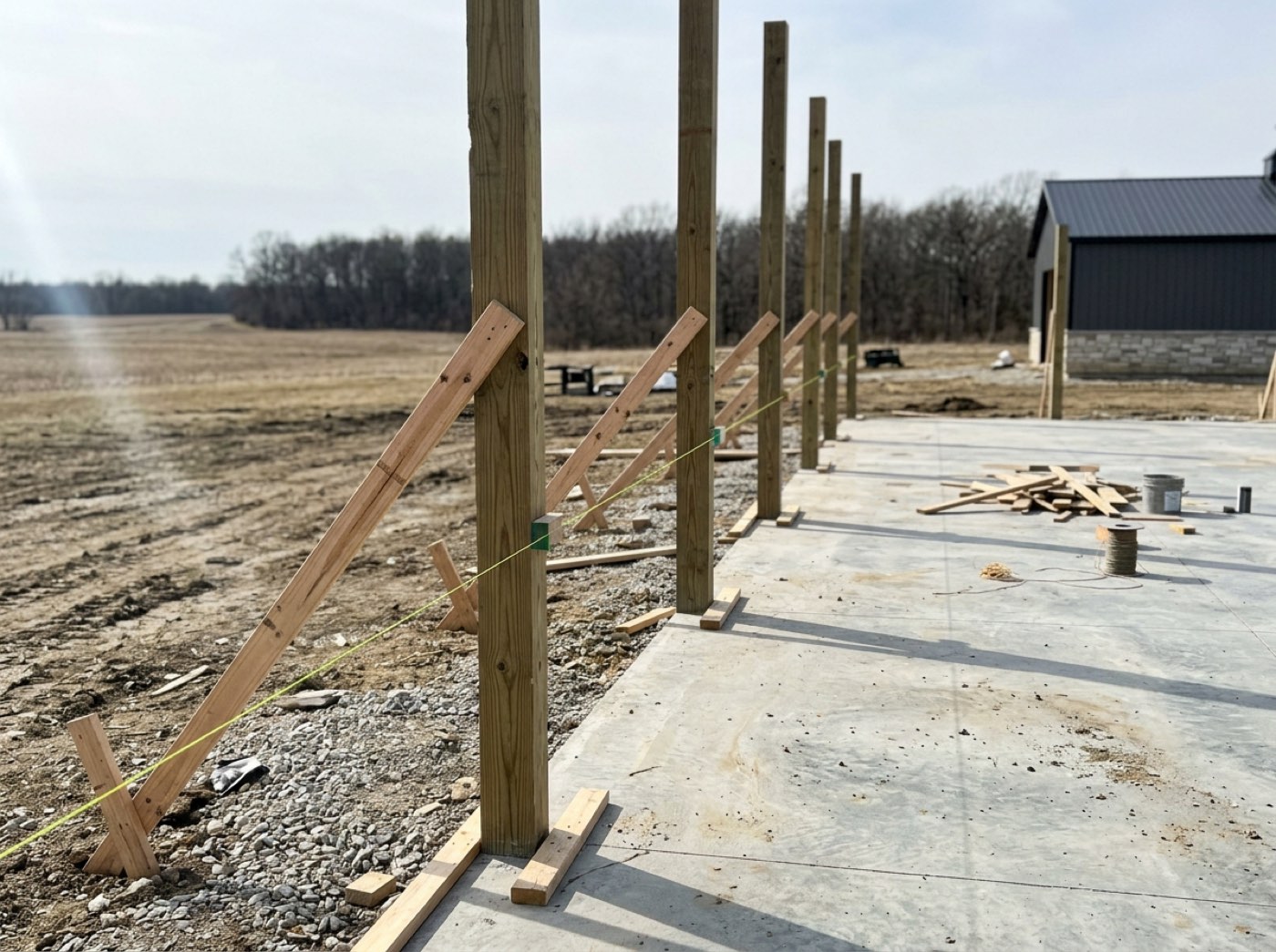
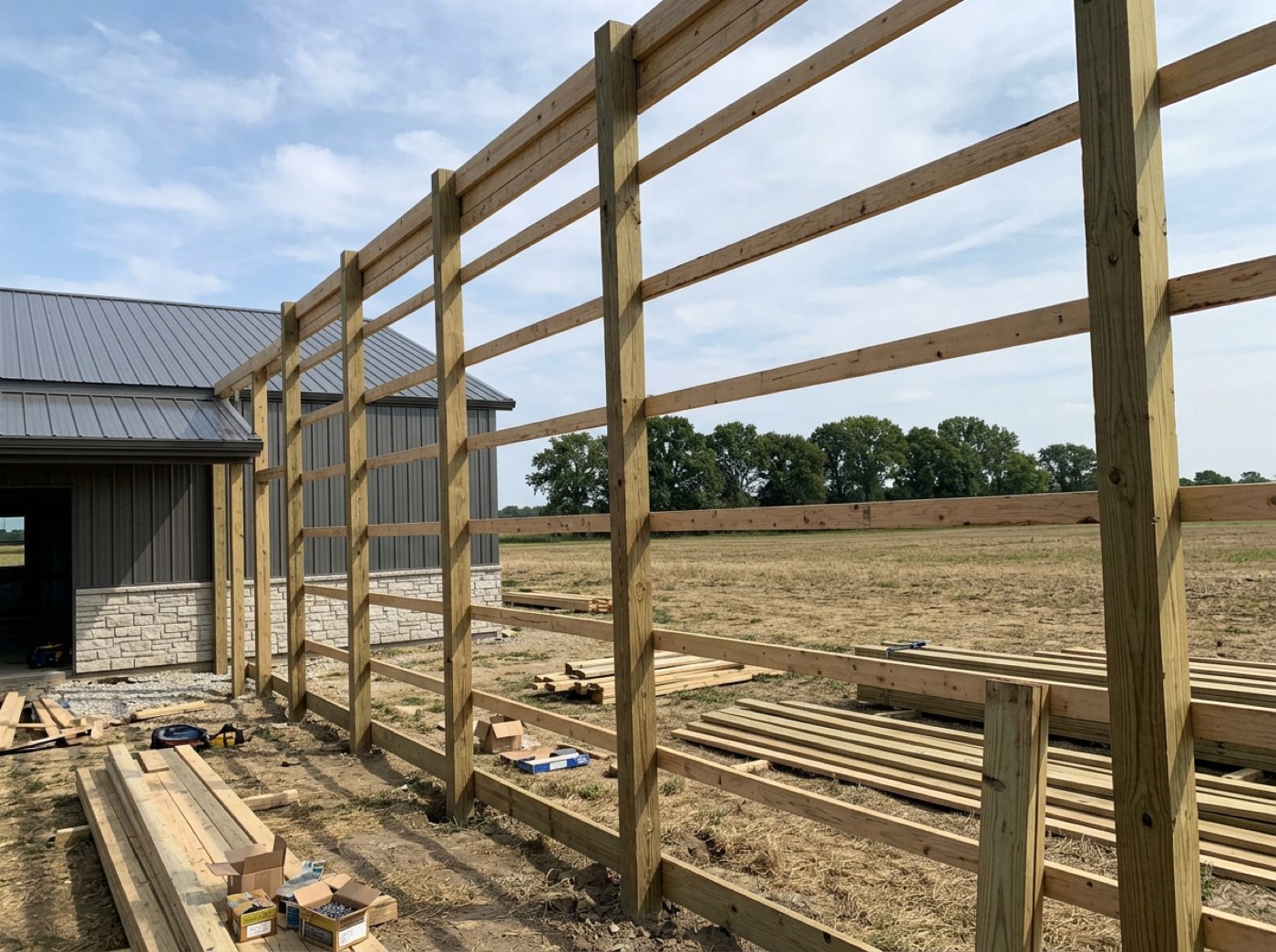
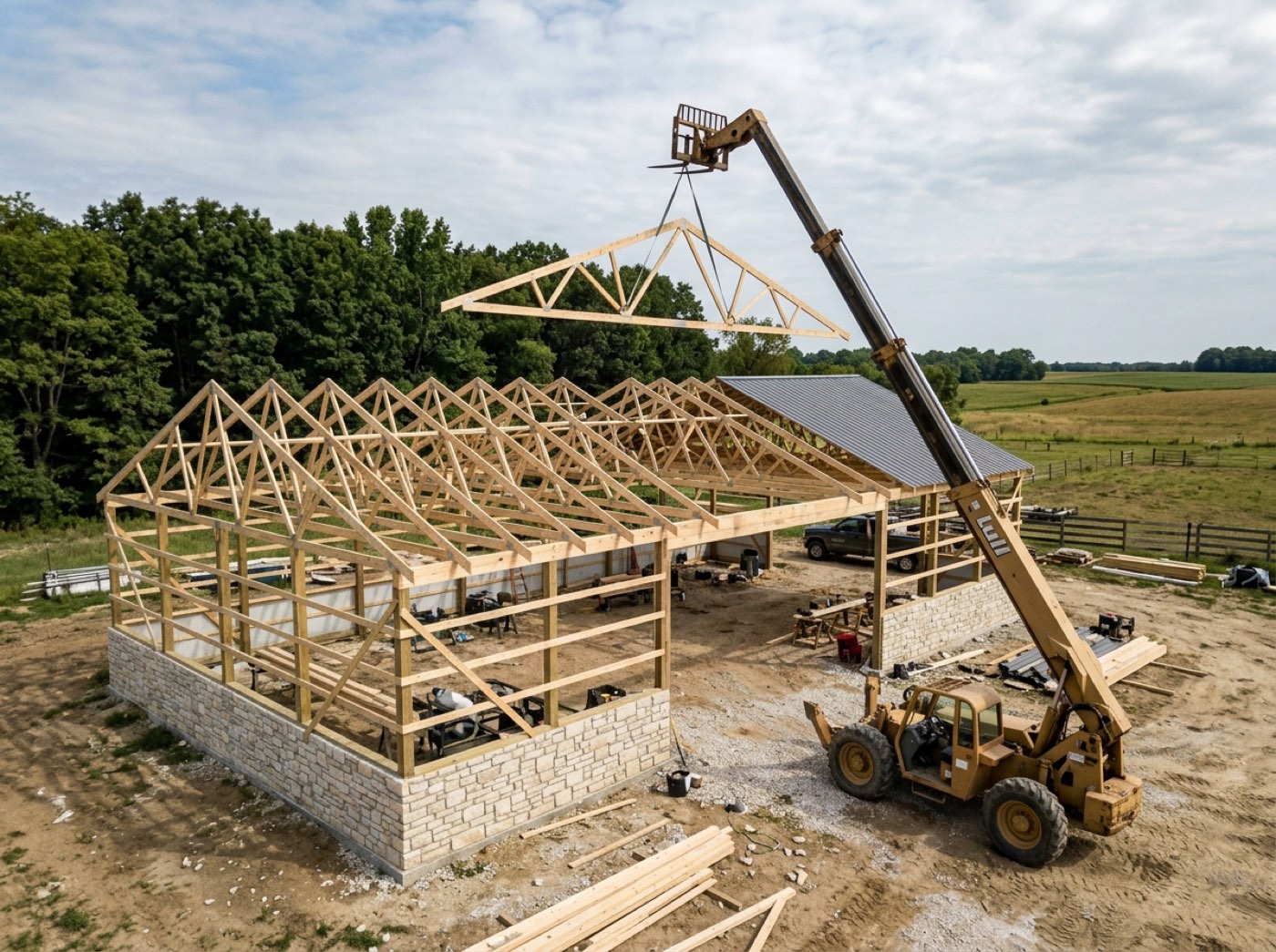
Each stage of a job carries the checkpoints that have to be ticked before it can close, and the ones that matter want a photo, taken before the work gets covered up. Backing in before drywall. Embedment depth before backfill. Fastener pattern before trim. The record stays on the job for good. So when a problem surfaces two or three years later, you open the job and see which crew built it, which checkpoints were ticked, and what the photo shows. If there was no checkpoint for that step, you add one, and every crew photographs it from the next job on. A problem you find once becomes one you check for every time.
Proof like this changes behavior. When teachers had to take time-stamped photos with their class, with pay tied to it, absence fell by 21 percentage points. When restaurants installed monitoring, theft dropped and productivity rose, and it came mostly from people changing what they did, not from firings.
One caution. Control that feels aimed at you reads as distrust, and in experiments most people worked less when a minimum was imposed on them. So apply checkpoints to every crew alike, and say plainly what they're for: the photos are the crew's proof if a callback comes. Use them for recognition too. Name the best-documented job of the month. Public recognition lifted later performance, mostly among the people who didn't get it that time.
With checkpoints in place, the owner who's afraid speed pay will only create more problems has his answer. Pay for speed, check for quality, and trace anything that slips.
Strikes: when there's no surplus to cut
A lower multiplier only bites when the crew is beating its figure. On a job that breaks even, there's nothing to take a share of. That's what strikes are for.
When people can see a path of raises, bonuses and titles ahead of them, they have something to work toward. If they choose not to, or worse, a filed report becomes a strike, and the strike stalls their momentum: it pauses their progress for a set number of days, restarts the climb to their next step, or takes away the next step's bonus. People feel losing ground far more than gaining it. Bonuses paid up front and taken back on a miss moved results far more than the same money paid afterwards, and factory teams responded more to a bonus framed as a loss.
Why a count beats a write-up in a drawer
An entrepreneur once put it simply: a strike works because it's tangible and finite. "You've been written up" is abstract, so it wears off. "Two more and your position is at risk" is something a man can count. A formal write-up still matters, because it's formal and nobody wants one. But the deterrent is the certainty. The research on deterrence is blunt: the certainty of a consequence deters far more consistently than its severity, and the certainty of being caught is a much stronger deterrent than the punishment itself. A strike everyone can see, written into the path before anything happens, that every filed report adds to, is certain.
It also protects the business. Three strikes doesn't have to mean dismissal, but it is a dated record of what happened, who reported it and who reviewed it, which is the first thing an attorney will ask for if a parting ever turns into a dispute.
Three rules keep strikes doing their job:
- Strike what someone did, never a number they missed. A crew with no surplus may have been handed a budget nobody could beat. When a daycare started fining parents for late pickup, lateness went up: the fine became a price. A routine strike for a slow job becomes the price of a slow job.
- Word the rules as guidance you may apply. A handbook that promises specific discipline steps can be read as an implied contract. Talk to your attorney about the wording.
- Some things can never be a strike. Employees have a legal right to discuss their pay with each other and to raise complaints as a group. And never strike, or cost anyone a reward, for reporting an injury. OSHA treats that as possible retaliation. Rewarding hazard and near-miss reports is always fine.
The "dummy hand": funding a bigger share without anyone paying for it
In some two-player card games you deal a dummy hand, so nobody can work out exactly what the other is holding. One idea for the surplus works the same way: split it by one or two more shares than there are men on the crew. A four-man crew's surplus is split five or six ways, and the extra share goes into a pool the company uses for future crew rewards, including a bigger multiplier for a lead, so nobody else's share pays for it.
The money idea is sound. The secrecy isn't, and we'd tell you that before you try it. Workers have a protected right to compare pay, so a hidden share won't stay hidden, and when people find out an expectation was broken, trust falls and they start looking. Also, a budget the crew can't see is a vague goal, and specific goals beat "do your best".
So keep the extra share and name it: the crew fund. "Your surplus is split five ways: one share for each of you and one for the crew fund. The fund pays for the lead's bigger share, the end-of-season bonus and the next good hire's sign-on." Better still, hold the crew fund like retainage and pay it out after the callback window. Contractors already hold back 5 to 10% until a milestone to guarantee quality work. A crew fund paid out only when the callbacks stay quiet ties speed, quality and staying until year-end into one reward.
One more thing on any surplus share: under federal law it's a non-discretionary bonus, so it belongs in the regular rate for overtime. A man with a 46-hour week is owed half-time on the bonus too. Check that your payroll does it.
Career paths: give people something to aim at
Ask a crew member at most builders what it takes to make crew lead and the honest answer is "when the owner decides". That isn't a goal anyone can work toward.
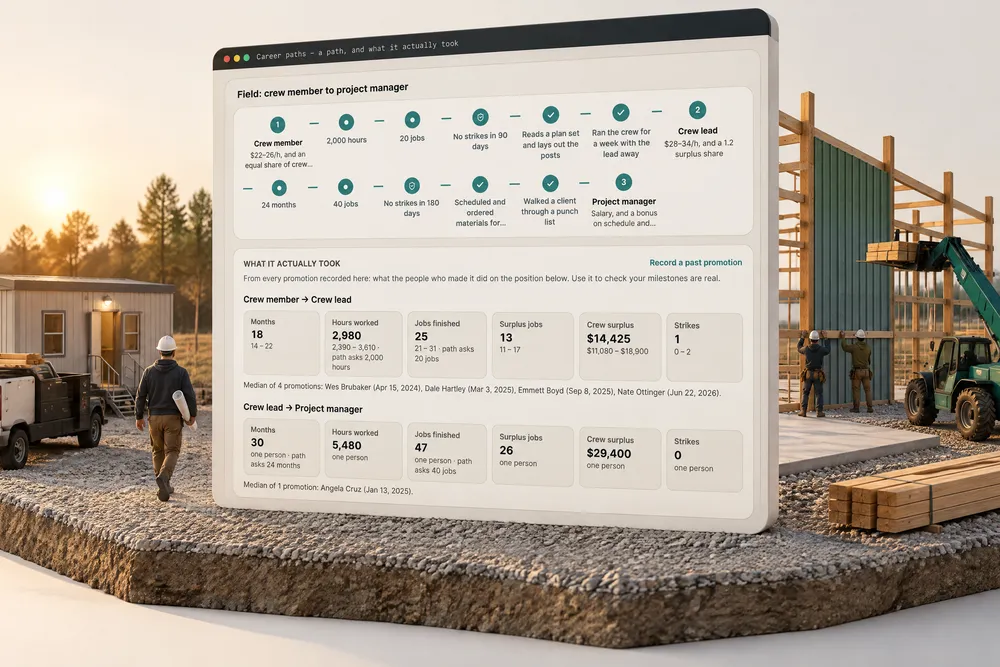
A career path is. Lay out the road from every position to the next: crew member to crew lead, crew lead to project manager, sales rep to sales manager. Show what each position pays and exactly what earns it: 2,000 hours, 20 jobs, 90 days without a strike, a sign-off that he can read a plan set and lay out the posts, a week running the crew with the lead away. Now he has something to aim at, and he can measure how close he is.
The evidence is on your side. People promoted from inside outperformed outside hires for their first two years and left less, while the outside hires were paid about 18% more. Specific, measurable goals with feedback beat vague ones every time. And in Gallup's research, 52% of people who quit said their manager or company could have prevented it, and 51% said nobody had talked to them about their future in the three months before they left. A career path is that conversation, written down. We'd expect a visible path to change who applies, too. That hasn't been studied directly for career ladders, but pay design clearly does it: at Safelite, about half the gain from the new pay came from attracting better workers.
Two things keep a path honest:
- The best seller isn't always the best manager. Across 214 companies, top sales performance raised the odds of promotion and was linked to sales declines afterwards: the best rep became a worse manager. Build a senior-rep step for the closer who wants to keep closing, and promote managers on coaching. The same goes for leads and PMs. Good bosses keep their people, so ask for people skills (trained a new hire, kept the crew together) as well as output.
- Be straight about the seats. A path motivates only if people believe they can make it. A 12-person builder with one PM seat shouldn't imply everyone gets one.
And here's the part no spreadsheet gives you. If every promotion is recorded, then after a few years your own records tell you what it actually took. How many hours did the people who made crew lead work first? How many jobs? How many surplus jobs, how many strikes? An owner who never sat down to design a career path still ends up with the data to design one, just by running payroll through the same system. That's how career paths work in Leads 2 Build.
Role by role
Every role in a post-frame or barndominium company responds to a different mix.
Sales reps. Pay commission on margin, not price: reps facing commission steps gave bigger discounts to hit them, costing 6 to 8% of revenue. Combine over-quota commission for your top reps with a quarterly pacer for the rest. Don't make your best rep the sales manager by default.
Crew labor. A small-crew surplus share, with the target shown in days and live progress, works through peer pressure. Lower the share of anyone the crew is carrying. Raise steps for proven skills, and recognize good work out loud: cross-trained crews finished about 30% faster by cutting handoffs. For new hires, several small bonuses at 30, 60 and 90 days beat one cliff at six months, because effort speeds up as a reward gets close and retention bonuses work best early.
Crew leads. A title plus a bigger surplus share, funded from the crew fund so crewmates don't pay for it. Status doesn't fade the way a raise does: people fully adapt to more income within about four years, but not to a rise in status. Part of the lead's reward should be crew retention and training, and the surplus should be gated on the checkpoint photos.
Project managers. A balanced bonus: margin, schedule and callbacks together, because pay on one measure pulls effort off the others. Pay the callback part after the warranty window. Promote PMs for people skills, not for being the best installer.
Office staff. Recognition and base pay over variable pay. Public recognition lifts performance, and people who don't feel recognized are about twice as likely to leave within a year. Set clear accuracy and turnaround targets with feedback, but never pay on one number alone.
For everyone who's proven and steady, the raise is still the right lever. Salary growth cut quits most among high performers in a study of 5,143 employees, and Ford's $5 day ended a turnover crisis and put lines of applicants at the gate. It just doesn't buy speed: workers paid more than they expected worked harder for a few hours, then went back to normal. Give raises for staying, and pair them with a title.
How it fits together
None of these levers works alone, and that's the point of putting them in one place.
The crew sees a career path: the next position, what it pays, and how close they are. Inside each position, a raise path marks the steps along the way, and each step gives the lever that fits it: a raise, a bigger share of the surplus, a bonus, PTO, a title. On every job, the shared surplus pays for speed, a lower share answers the man the crew is carrying, and photo checkpoints make sure speed never means skipping what gets covered up. When someone slips, a strike stalls their progress, counted and visible, with what it does written down in advance. And every promotion, raise, strike and checkpoint is recorded, so in a few years you know what your best people actually did to get where they are.
That's what we built into payroll progression in Leads 2 Build, which works exclusively with post-frame and barndominium builders. When you set up a step, Which reward? starts from the problem on your jobs and shows what each lever drives, why people respond to it and what to watch for, with every study linked. You can see it on progression rewards, and the whole pay system on Crew Pay & Payroll.
The result is the thing every builder actually wants: people who stay, crews who work hard because it pays them to, less of the behavior you don't want, and quality you can prove years after the job is done.
A summary of research, not legal advice. Pay law varies by state: check bonus, deduction and discipline policies with your attorney or payroll provider.