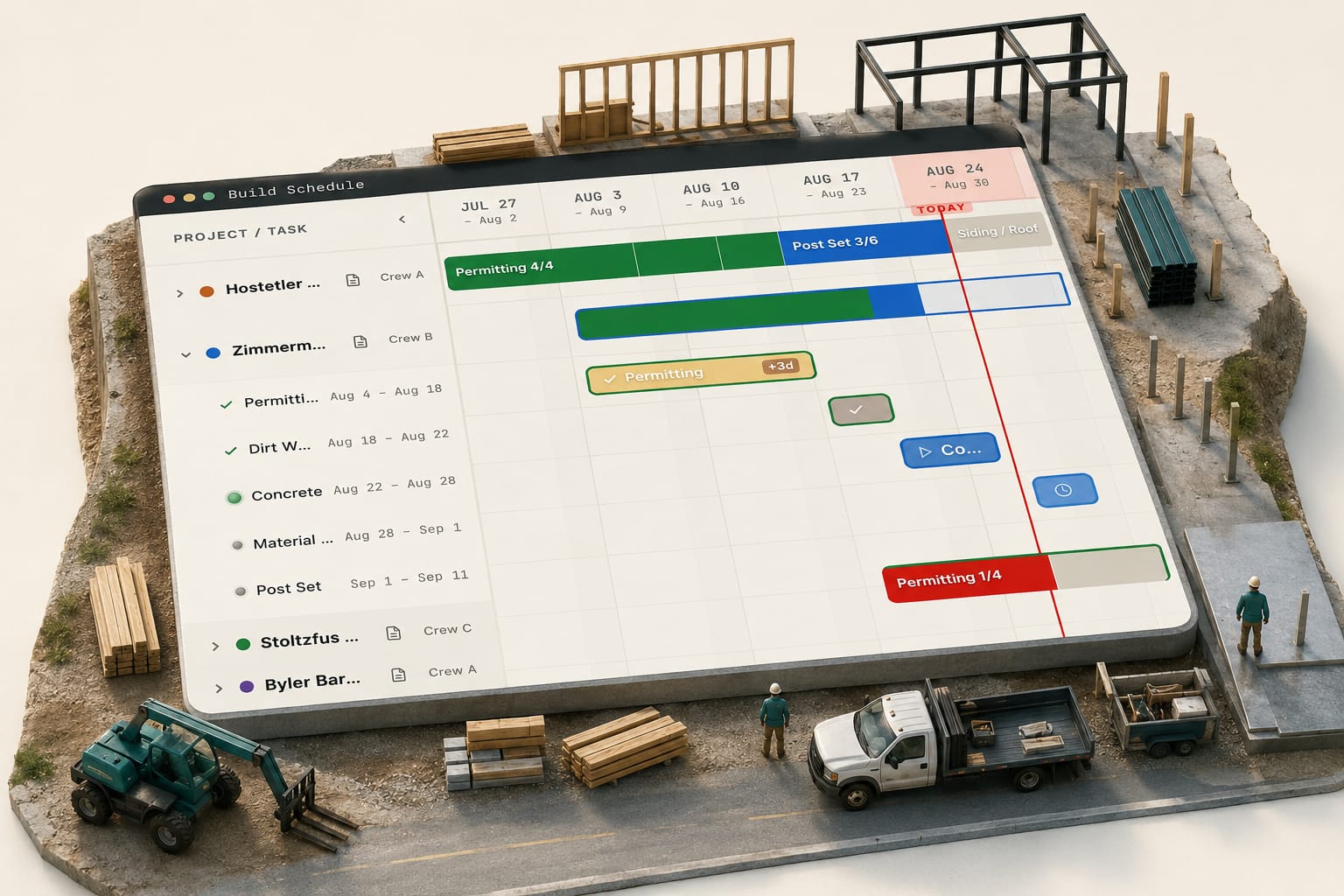
The short answer: The best software for post frame builders is the kind that runs the jobs you build, from lead and estimate through draws, crew schedule and handover, not the kind that vets subcontractors for companies that hire them. Both carry the label "contractor management." Sort the list by the shape of your company first, then test each tool on one real building before you buy.
Search "contractor management software" and page one hands you two different products wearing the same name. One is built for companies that hire contractors and need to prove those contractors carry insurance. The other is built for companies that are the contractor. Both categories are full of good software, and buying across the line is an easy mistake to make and a slow one to unwind.
This sorts the two apart in about ten seconds, then lists the construction software for small business that actually runs a building company — organized by the shape of company each one genuinely fits, including where we fit and where we don't.
Two products, one name
Category one: managing the contractors you hire. This is compliance software. It keeps a W-9 on file for every vendor, tracks certificates of insurance so nobody works on your site with a lapsed policy, holds safety records and prequalification packets, and produces 1099-NEC forms at year end. Workday and ADP come at it from the workforce and payroll side. ISNetworld and Avetta come at it from the other direction — they are networks that facility owners and large general contractors require their subs to join. This category exists because worker classification has real consequences; the IRS's own test for who counts as an independent contractor is worth ten minutes of any builder's time regardless of what software you run.
Category two: managing your contracting business. Leads, quotes, contracts, schedules, crews, change orders, invoices. You are the contractor. The software's job is to move a building from a phone call to a paid final invoice without anything getting retyped.
The ten-second test: read the vendor's home page and see whether it talks about onboarding vendors or about winning and running jobs. That single sentence tells you which category you're standing in.
Most post-frame builders need category two. If you sub out the concrete flatwork, the excavation and the electric — three or four trades you've used for years — you do not need a prequalification network. You need a folder of current COIs and a calendar reminder before each one expires. The moment you're carrying twenty subs across three states, revisit that.
What "management" actually covers on a 40x60
Take one ordinary job: a 40x60 shop, 14-foot sidewalls, a 12-foot open lean-to down one side, two overhead doors, posts at 8-foot spacing, trusses spanning 40 feet, purlins carrying 29-gauge panel cut to length.
That single building produces the same seven records every time:
- The estimate — the material list the geometry dictates, priced.
- The proposal — the same numbers, arranged so a customer can say yes.
- The contract — the same numbers again, plus terms and a signature.
- The draw schedule — deposit, delivery, post-set, dry-in, final. A $14,000 draw at dry-in has to match a contract total that has already changed twice.
- The build schedule — stages, crew, and the weather window that decides whether posts go in this week.
- The change orders — the customer adds the 12-foot lean-to in week two, and that is a new post count, new trusses, new panel, new price.
- The invoices — each draw, billed against what the contract actually says today.
Contractor management software is judged on exactly one thing: how many times a human being retypes those seven records. Every retype is a chance for the contract and the invoice to quietly disagree, and by the time you find out, the customer has the older number in their hand.
The list, sorted by who it fits
Compliance side, if the subs you hire are the problem:
| Tool | Good at | Fits |
|---|---|---|
| ISNetworld / Avetta | Contractor prequalification networks — insurance, safety statistics and documentation held to a hiring client's standard | Owners and large GCs vetting subs at scale, and any sub whose customer requires membership |
| Workday / ADP | Contingent workforce, payroll and tax reporting inside one HR system | Companies large enough to have HR as a department rather than a person |
Build side, if running the work is the problem:
| Tool | Good at | Fits |
|---|---|---|
| Buildertrend | The most mature residential suite in the category: scheduling, selections, budgets, client portal, financing | Custom-home builders and remodelers with a real back office to drive it |
| Contractor Foreman | Unusual breadth — dozens of modules from daily logs to time cards — at the low end of the market | Small general contractors who want maximum coverage per dollar |
| JobTread | Budget-first job costing end to end, with transparent pricing and an active user community | Builders who run the company off cost control and want one spine for it |
| Jobber | Quoting, scheduling, invoicing and payments for crews doing repeatable visits, with the easiest adoption curve here | Service businesses — the crew-and-a-truck model, many small jobs |
| Procore | The commercial standard: drawings, RFIs, submittals and subcontractor management on large projects | Commercial GCs working from plan sets, with project engineers to run them |
| Knowify | Contract and progress billing tied closely to QuickBooks, with job costing underneath | Trade contractors who bill in progress against a schedule of values |
| Leads 2 Build | The post-frame path specifically: a 3D estimate derived from the building's geometry, a customer portal, e-signature, draws, change orders and invoices from the same numbers | Post-frame and pole-barn builders who design the building on the call |
None of those are bad tools. Every one of them is excellent inside the assumption it was built on. The assumption is the thing to check — a suite built for a custom home assumes a plan set and a selections process; a service platform assumes short repeatable visits; a commercial platform assumes an owner, an architect and a submittal log. A post-frame shop has none of those and has something they don't: a building whose entire material list is a function of six dimensions.
Where we put ourselves, and where we don't
We built Leads 2 Build for the second half of that sentence. Change the shop from 40x60 to 40x72 and the post count, truss count, purlin run, panel lengths, trim and price all move together, because the model derives them rather than storing them as typed lines. That estimate becomes the proposal the customer opens, the contract they sign, the draw schedule they get billed on, and the invoice that pushes to QuickBooks — one number the whole way. Change orders price themselves into the total, which matters more than it sounds: a verbal lean-to is the most expensive habit in this trade. The whole flow is here, and what each plan includes is here.
Where a different shape of business outgrows us: if you bid commercial work off architect drawings, you want a takeoff and submittal platform, not us. If your revenue is fifty small service calls a month, a service platform will fit your day better.
Concretely, the part we do own end to end is the run from enquiry to signed contract: one board with every lead on it, and a contract that writes itself from the approved estimate instead of being retyped from it.
What the research says
- A long list makes people put off the decision, mostly when the options are hard to compare. In a meta-analysis of 99 observations (N = 7,202), Chernev, Böckenholt and Goodman found choice overload grew with complex options, hard decisions and uncertain preferences, and showed up as regret, deferral and switching. Sorting software by who it fits cuts the list to the few worth a demo.
- Most builders still run without dedicated software. In NAHB's 2019 technology survey of 508 builders, only a little over 20% used construction management software, while about two-thirds used technology to schedule subs. The tool that wins is usually the one that replaces the habits a small office already has.
- Scattered information costs hours every week. In the FMI and PlanGrid study, construction staff spent about 5.5 hours a week looking for project information and 3.9 hours on mistakes and rework (a sample leaning toward larger commercial firms). On a post-frame job that is the truss spec, the lean-to price or the door size the customer agreed to in the yard.
- People keep using a tool when it helps with the work, more than when it is simply easy. In Davis's study of 152 users across four programs, how useful a tool felt tracked actual use (r = .63) more closely than ease of use did (r = .45). Judge each option by whether it does a post-frame job's real steps, not by how slick the demo looks.
The buying test, in under a minute
Put every vendor on your list — us included — through the same four asks on the demo call:
- "Model my last building." 40x60, 14-foot walls, 12-foot lean-to, two overhead doors. Watch how it gets entered and how long it takes.
- "Now move an overhead door to the gable end and show me the price change." Either the materials re-derive or someone edits a line.
- "Show me the change order the customer signs." Not the note field. The document.
- "Show me the invoice, and tell me where those numbers came from." If the answer includes retyping, you've found next year's discrepancy.
If you want the same evaluation run against estimating tools with verified pricing, we did that separately in the builder's short list. The billing half is covered in construction invoicing software, and the part that decides whether the job stays profitable once it's sold is the schedule.
Here's the honest limit. We manage your business, not your vendors — there's no COI expiry tracker, no prequalification packet, no 1099-NEC run. If you're carrying enough subs that compliance paperwork is a real job, you'll run something from the first table alongside us, and your accountant will still handle year end. That's a gap we haven't closed, and the National Frame Building Association is a better place than any software vendor to ask what your peers do about it.