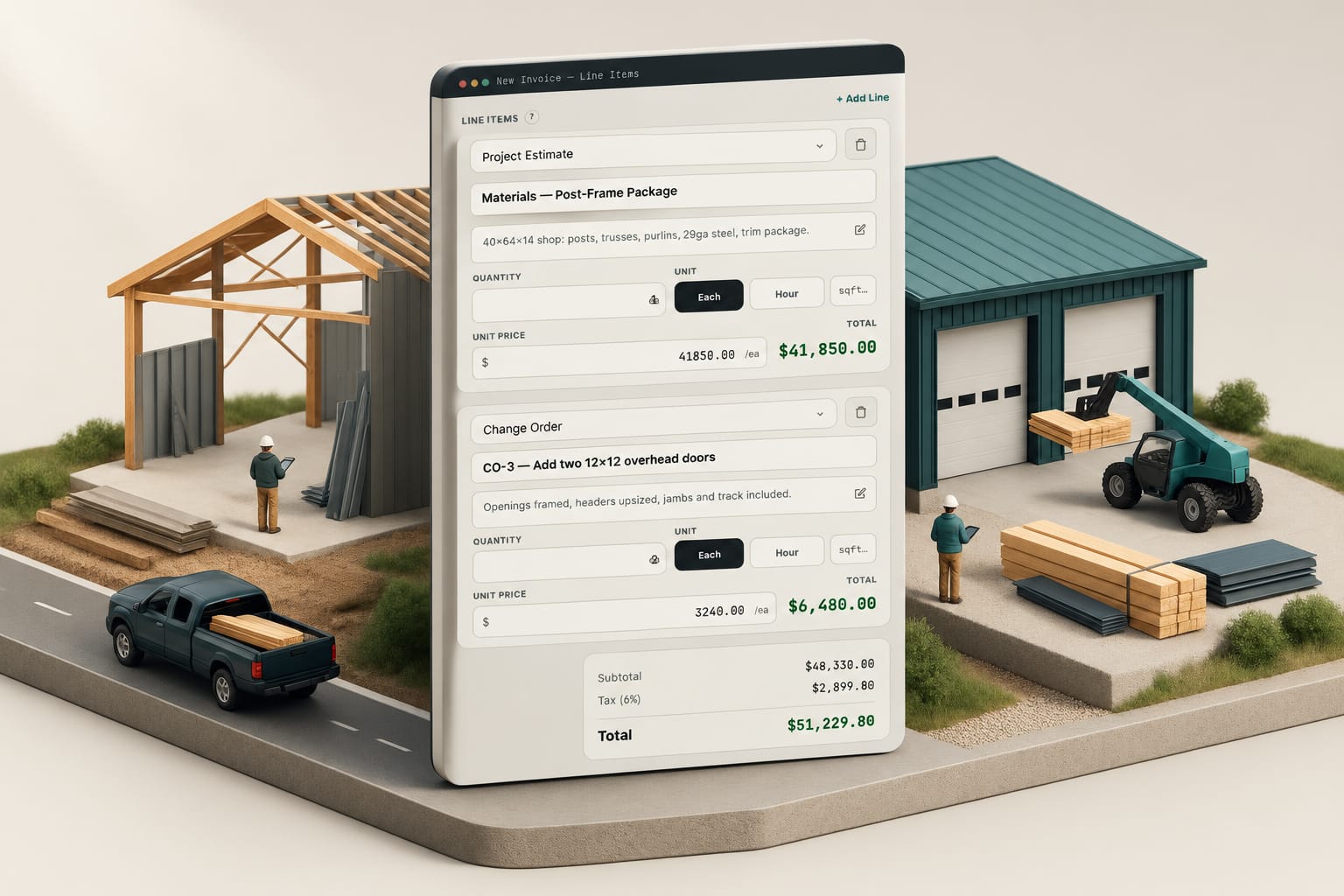
Most invoicing software is built on a simple assumption: you do work, you send a bill, they pay it. For a plumber, that's the job. For a post-frame builder, it describes maybe a fifth of what has to happen between contract and final payment.
Here's what invoicing actually has to handle for a building company, what to test before you buy anything, and where general accounting tools genuinely stop.
What construction billing has that service billing doesn't
Deposits. Money before anything is ordered — which is not revenue yet, and your accountant cares about the difference.
Draws. Payments tied to stages. Post set, framing, steel, completion. Each one has to be triggered by something happening on a site, not by a date on a calendar.
Change orders. Signed mid-job, each with its own price and date, each of which has to reach the final invoice intact. This is where the most margin quietly disappears, and it has its own playbook.
Retainage. In some contracts, a percentage held back until completion — which has to be tracked, aged, and eventually collected.
Lien deadlines. Jurisdiction-specific, unforgiving, and tied to dates your billing system already knows.
A tool that treats an invoice as a single event handles exactly none of these. That's not a flaw — it was built for different work.
The five questions to ask any vendor
Run these in a demo. They sort the category in about four minutes.
1. "Show me a draw schedule tied to build stages." Not recurring dates. Stages. If the answer is "you'd set up recurring invoices," it's a service tool.
2. "A change order gets signed on Tuesday. Show me it reaching the final invoice." Watch how many manual steps there are. Every one is a place it gets forgotten.
3. "Where does the invoice's number come from?" If the answer involves retyping from an estimate, the estimate and the invoice can silently disagree — and they will.
4. "Show me retainage." Held back, tracked, released. Many otherwise-excellent tools simply have no concept for it.
5. "How does this reach my accountant?" A real QuickBooks or Xero sync, or an export someone re-keys? Re-keying is a monthly tax you'll pay forever.
Where the honest boundaries are
Every tool here is good at what it was built for — the question is fit, not quality.
| Kind of tool | Built for | Where it stops for a builder |
|---|---|---|
| QuickBooks alone | The books — the ledger every accountant expects | It doesn't know your jobs, stages or change orders, so invoices get typed by hand from somewhere else |
| Field-service platforms (e.g. Jobber) | Repeatable visits, quoted and invoiced fast | Designed around a visit, not a multi-week build with staged draws |
| Construction management suites (e.g. Buildertrend, JobTread) | Budget-to-job-costing across a whole build | Genuinely capable here — the question is whether the estimating side fits how you price a post-frame building |
| Post-frame estimating tools | Deriving the building and its price | Most end at the estimate; billing lives elsewhere |
If you're weighing the estimating side of that same decision, we laid out all three camps with real 2026 pricing in the builder's short list — and when the building is already priced, what SmartBuild estimating leaves for the draws is this same gap seen from the estimating end.
The retyping test
One question tells you whether you have an invoicing problem or an invoicing system:
When you produce an invoice, do you type a number that already exists somewhere else?
If yes, three things follow. Your estimate and your invoice can disagree. Your job-costing is assembled by hand after the fact, if at all. And every change order is one act of forgetting away from being free work.
That's the gap our own billing sits in, stated plainly: the estimate becomes the contract, the contract sets the draw schedule, signed change orders add their own lines, invoices are generated from those numbers rather than re-entered beside them, and the whole thing syncs to QuickBooks so the books and the job agree by default. Here's the whole path, and the branded portal is where the customer sees what they owe and pays it.
That test is the reason we push invoices into QuickBooks itemised rather than as a single total: if the bookkeeper has to retype a line, the software failed the test no matter what the feature list said.
What to do before you buy anything
Take your last completed job and write down, honestly:
- How many times a number was typed that already existed elsewhere
- How many days between "stage done" and "invoice sent"
- Whether every change order made it onto the final bill
- How long the month-end reconciliation took
Those four numbers are your actual business case. If they're small, a good invoice template and QuickBooks is genuinely the right answer, and it's cheap. If any of them made you wince, you've found what to fix — and now you know exactly which demo questions to ask.
For contract and billing standards the industry leans on, AIA's contract documents are the common reference, and the National Frame Building Association carries the post-frame-specific material.
One open loop: faster invoicing doesn't fix late payment if the customer is annoyed. Collection is downstream of expectation — and expectation is set by the schedule, which is its own discipline.