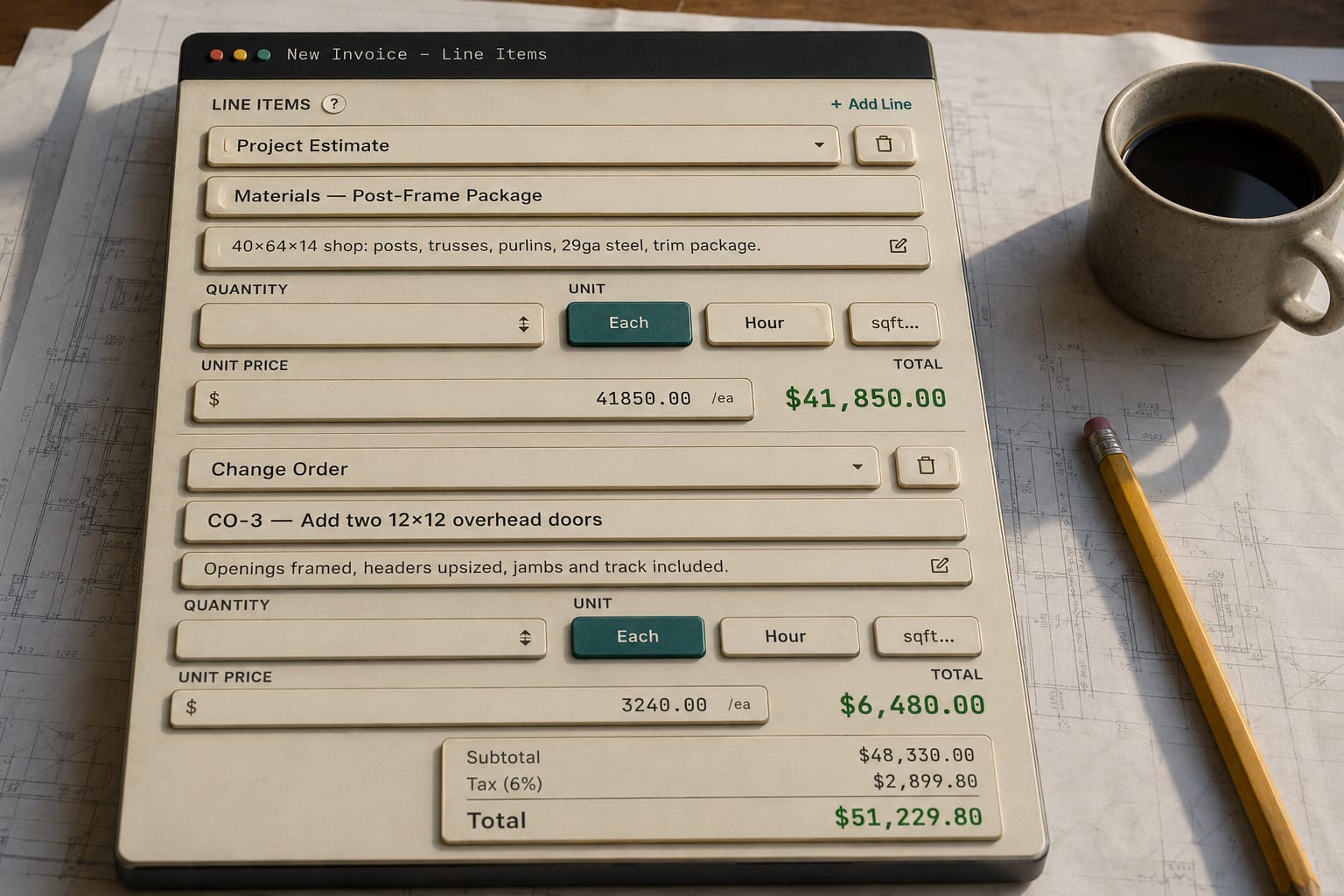
Most contractor invoice templates you'll find online were built for someone who finishes the work, hands over a bill, and gets paid. That is not a post-frame job. A 40×60 shop takes a deposit before anything is ordered, a draw when the posts are set, another when the steel goes on, and a final invoice that has to survive a change order the customer half-remembers agreeing to.
So the template matters less than what's on it. Here's the invoice a building company can actually collect on, the six fields that decide whether it gets paid this week or next month, and the point where a template stops being the right tool.
What an invoice is actually for
An invoice is not a request. It's a record that says: this is what we agreed, this is what's been delivered, this is what's owed, and this is when. Every one of those four has to be answerable without a phone call, because the phone call is where payment goes to die.
The uncomfortable arithmetic: chasing a $14,000 draw for three weeks costs you the same as a $400 mistake on the material list, except you'll notice the material mistake. Nobody tracks the cost of slow collection, which is exactly why it stays expensive.
The six fields that decide whether it gets paid
Everything else on an invoice is decoration. These six are load-bearing.
1. What it's for, in the customer's language. Not "Progress billing #2." Write "Draw 2 of 4 — posts set and framed, per the agreement dated April 3." A homeowner who can match the line to something they can see out the window pays it. One who can't, forwards it to their spouse and forgets.
2. What was agreed, not just what's owed. Contract total, less what's already been paid, less the deposit, equals balance. Show the arithmetic. An invoice that shows its work never generates a "wait, I thought…" email.
3. Change orders, itemised separately. Every signed change order gets its own line with its own date, which is easiest when it was signed electronically on the spot rather than agreed out loud and chased later. Bury it in a lump sum and you've just re-opened a settled conversation at the worst possible moment.
4. A due date, not terms. "Net 15" is a term of art. "Due April 28" is a date a person can put in a calendar. Same meaning, materially different collection speed.
5. How to pay, on the invoice itself. If paying requires the customer to find a phone number, ask what to make the cheque out to, and drive somewhere, you have added days to your own cash cycle for no reason.
6. Who to ask. A name and a number. Not "accounts."
A template you can copy
Everything above, in the order it should appear:
| Section | What goes in it |
|---|---|
| Header | Your legal business name, address, phone, email, licence number if your state requires it on billing |
| Invoice number & date | Sequential, never reused. Your accountant will thank you and an auditor will insist |
| Bill to | The name on the contract — not the spouse who answers the phone |
| Project | Address, and the building in plain words: "40×60 shop, 14′ walls" |
| Line: base contract | Contract total, agreement date |
| Line: each change order | CO number, date signed, amount — one line each |
| Line: payments received | Deposit and every draw, dated |
| Balance due | Contract + change orders − payments |
| Due date | An actual date |
| Payment methods | Every option you accept, with the link or details inline |
| Notes | Retainage, warranty start, lien-release status if applicable |
That's it. A one-page document. If yours runs to two, something on it isn't earning its place.
The three mistakes that cost real money
Invoicing from memory instead of from the estimate. The estimate said $18,180. The invoice says $18,000 because someone rounded while retyping. You just donated $180 and, worse, introduced a discrepancy the customer may notice on the next one — at which point every number you send is suspect.
Letting a verbal change ride until the final invoice. This is the single most expensive habit in post-frame, and it deserves its own treatment — we wrote it up here. The short version: the final invoice is the worst possible venue for a first conversation about money.
Billing on dates instead of stages. "Invoice on the 1st and 15th" bears no relationship to what got built. Bill when a stage completes and the invoice explains itself.
When a template stops being enough
A template is a document. It doesn't know what you quoted, whether the customer signed the change order, or whether draw 2 was ever paid. You do — until you're running six jobs, at which point you're maintaining that knowledge in your head, in a spreadsheet, and in QuickBooks simultaneously, and the three disagree.
The tell is simple: if you retype numbers to produce an invoice, you have outgrown the template. Retyping is where estimates and invoices silently drift apart, and reconciling them later is a night's work you didn't quote for.
That's the gap our own invoicing sits in. The estimate produces the contract, the contract produces the draw schedule, signed change orders add their own lines automatically, and the invoice is generated from those numbers rather than re-entered beside them — then pushed to QuickBooks so the books and the job agree by default. Here's the whole flow, lead to paid.
The line where a template stops paying for itself is usually the third revision of the same invoice. Invoicing built on the estimate means the numbers are already there — and approved change orders arrive on the invoice instead of being remembered.
Before you send the next one
Three checks, thirty seconds:
- Does the balance arithmetic appear on the page, or does the customer have to trust it?
- Is every change order on it signed, dated and separately listed?
- Could the customer pay it in the next two minutes without leaving the email?
If any answer is no, that's where your collection time is going.
For the trade's own standards and contract references, the National Frame Building Association is worth the membership. And if you want the broader picture of what should happen between "signed" and "paid," start with how a post-frame estimate should be built in the first place — an invoice can only be as clean as the estimate it came from.
One honest open loop: none of this helps if the job's schedule slipped three weeks and the customer is annoyed before your invoice arrives. Collection is downstream of expectation, and expectation is set by the schedule — which is its own discipline entirely.