Permit reference
A Pole Barn Permit Turns on Parcel and Use, Not Square Feet
Whether a pole barn permit is required comes down to who governs the parcel and what the building is for. Here is how that plays out across 640 counties in 13 states.
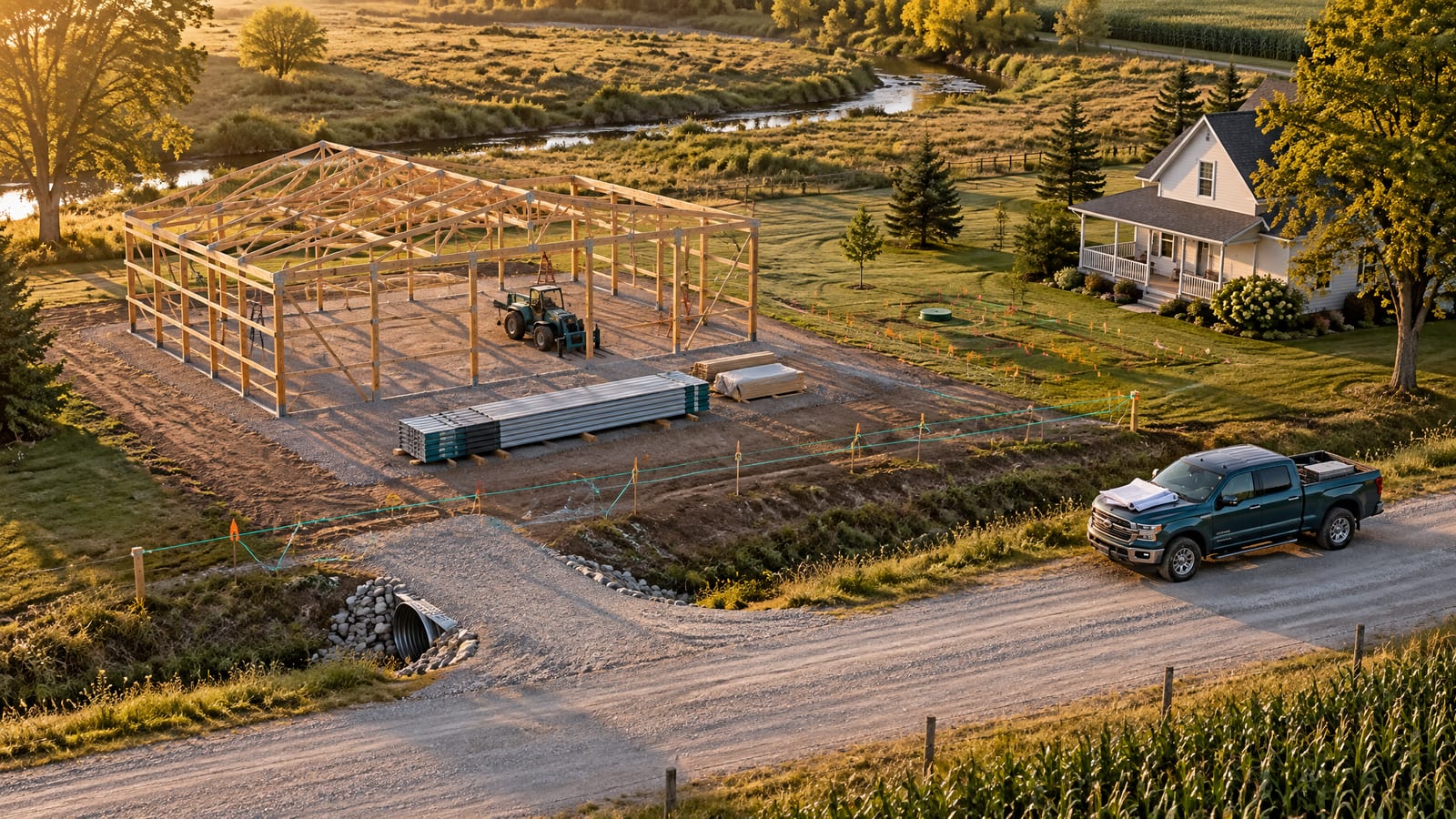
What decides a pole barn permit, in order
A pole barn permit is decided by four things, in order: who governs the parcel, whether that office issues permits at all, what the building will be used for, and what is on the site. Square footage is rarely one of them. Where a county rule names a small-building exemption, it is most often 120 or 200 sq ft. A 30x40 is 1,200.
Across the 640 county rules in our dataset, 226 counties require a county permit for a post-frame building on unincorporated land, 124 say it depends, and 288 have no county building permit at all.
That last group is where quotes go wrong. 287 of those 288 rules still point to a septic permit for any building with plumbing, and 267 name a floodplain permit for a parcel in a mapped flood zone. No county permit is not the same as no permit.
Six checks before you quote the building
The order a rep can run on the first call.
Pin the parcel, not the town name
Inside city limits the city's code governs; outside, the county's. The parcel on the edge of town is the one that gets answered wrong. In Wisconsin and Minnesota, the town or township can add an approval of its own.
Find out what the county actually runs
A building department with plan review and inspections, a zoning certificate with no inspector, or no county building permit at all, the case in 88 of Missouri's 115 in our data.
Get the use in writing
Machine shed, hay storage, hobby shop, shop with an apartment. The farm exemption turns on use, often on acreage too, and living space usually ends it. Settle it on the lead, not at the county counter.
Walk the site triggers
Floodplain, septic and a new driveway or culvert are separate approvals. 538 of 640 county rules name a road-access permit. In Stone County, Missouri, a site not on sewer needs the health department's permit before the building permit.
Ask about stamped plans and setbacks
157 of the 640 county rules can require engineered, stamped plans. Setbacks decide where the building sits: Stone County's form sets 25 feet front and back and 10 feet each side, measured from the road easement.
Price it and write it down
Put the permit, plan review, engineering, septic and floodplain work on the quote as lines, not assumptions. Where the office hasn't confirmed a figure, carry an allowance and label it. Note who you spoke to, and the date.
The farm exemption, in the words of five state laws
Several states write the farm exemption into law, and the wording decides who qualifies. Five of them:
- Iowa (Iowa Code §335.2): county zoning does not apply to farm houses, barns and outbuildings "primarily adapted, by reason of nature and area, for use for agricultural purposes, while so used." Claiming it for a barn needs no application or fee. Floodplain rules still apply.
- Illinois (55 ILCS 5/5-12001): counties may not "require permits with respect to land used for agricultural purposes." Setback lines still apply.
- Kansas (K.S.A. 19-2960(d)): exempt while "used for agricultural purposes and no other." "Dwellings, garages and other similar accessory buildings" don't qualify.
- Nebraska (Neb. Rev. Stat. §23-114.03): county zoning reaches every building except those used for agriculture on a farmstead of 20 acres or more producing $1,000 or more of farm products a year.
- Minnesota (Minn. Stat. §326B.121): the State Building Code does not apply to agricultural buildings, apart from a few state requirements, floodplain and electrical inspection among them.
These limit county rules; inside city limits, the city decides. And the exemption follows the use: the same 40x60 can be exempt as a machine shed and need a permit once it becomes a hobby shop.
What a 40x60 permit costs in four real counties
Fees follow the county's method, not the building. Of our 640 county rules, 283 charge no county building-permit fee, 99 charge a flat fee, 95 go by construction value, 52 by the square foot, 18 mix methods and 93 don't publish enough to say. One of each, for a 40x60 accessory building:
| County | How it charges | 40x60 accessory building |
|---|---|---|
| Gentry County, MO | No county building code | $0; septic and floodplain are separate |
| Barton County, KS | Flat fee | $25 |
| Stone County, MO | 20 cents per sq ft of footprint | $480 |
| Goodhue County, MN | By value, plus 65% plan review and a state surcharge | About $1,000 at a $45,000 value |
From published county schedules and Missouri's county-codes data, checked September 17, 2026.
Snow loads and frost lines don't check for a permit
An exemption removes the paperwork, not the load. A Minnesota farm building sits outside the State Building Code but under the same snow: the state's map puts ground snow at 50 psf south of its line and 60 psf north, or 35 and 42 psf on the roof under the residential code. Minnesota keeps one structural rule for them: translucent light panels or skylights without raised curbs must carry the same load as the roof around them.
Where a county has no code, nobody reviews the design, so the number is yours. Of the 429 rules in our data that record design loads, roughly two in three note that the figure is a regional norm, not one the county sets. Frost depths noted run from about 12 inches in Arkansas and Oklahoma to 48 or more up north. Write the snow load you designed to on the quote.
State by state: what 640 county rules say
Counts of the county rules we hold, for unincorporated land. Coverage grows county by county: Iowa and Missouri are complete (Missouri's 115 counts the City of St. Louis); Tennessee is two. Read the small rows as examples, not the state.
| State | Counties | Permit required | Depends | No county permit | Farm exemption, where a permit applies | Stamped plans possible |
|---|---|---|---|---|---|---|
| Arkansas | 26 | 1 | 1 | 24 | 1 of 2 | 1 |
| Illinois | 89 | 44 | 15 | 29 | 53 of 59 | 29 |
| Iowa | 99 | 42 | 38 | 19 | 79 of 80 | 20 |
| Kansas | 102 | 41 | 13 | 47 | 46 of 54 | 16 |
| Kentucky | 6 | 1 | 3 | 2 | 4 of 4 | 5 |
| Minnesota | 38 | 25 | 9 | 4 | 27 of 34 | 29 |
| Missouri | 115 | 21 | 6 | 88 | 15 of 27 | 15 |
| Nebraska | 55 | 24 | 26 | 5 | 40 of 50 | 14 |
| Oklahoma | 71 | 6 | 2 | 63 | 4 of 8 | 11 |
| South Dakota | 13 | 13 | 0 | 0 | 3 of 13 | 6 |
| Tennessee | 2 | 0 | 2 | 0 | 2 of 2 | 0 |
| Texas | 6 | 0 | 0 | 6 | n/a | 0 |
| Wisconsin | 18 | 8 | 9 | 1 | 9 of 17 | 11 |
| All 13 states | 640 | 226 | 124 | 288 | 283 of 350 | 157 |
"Depends" turns on use, acreage or location. One county each in Illinois and Kansas is unresolved. All 646 rules, six cities included, were last verified in June 2026 and cite 5,035 sources; 309 are graded high confidence and 486 carry a call-to-confirm flag. Rules change, so confirm with the county or city before you quote.
Check the permit on the lead, before the price
In Leads2Build the permit check lives inside the deal. It fills itself from the contact's address, street included, because which side of a town line the parcel sits on changes the answer. Leads that arrive with an address are checked as the pipeline board loads, and the card names the office that rules. Each answer is frozen onto the deal with who ran it and when, so the rule you priced on stays put.
One card says what it knows, and what it doesn't
The answer is one card: a green, amber or red verdict, a typical 40x60 cost, the farm exemption, stamped plans, the fee, the review time, the office's phone number and links to the sources. A confidence badge sits beside the name, and a rule nobody has confirmed by phone carries a "Call to confirm before quoting" strip. Inside a town, the town's rule governs and the county's shows beneath it. The tables above come from the same rules the check reads.
Run the check on a lead you're quoting this week
Questions builders ask
Do I need a permit to put a pole barn on my property?
It depends on who governs the parcel and what the building is for. In our data, 226 of 640 counties require a county permit on unincorporated land, 124 depend on use or location, and 288 have none. Inside city limits the city's code applies, and septic, floodplain and driveway approvals can apply anywhere. Call with the parcel address, not the town name.
How big of a pole barn can I build without a permit?
Not one big enough to be a pole barn. Where a county names a small-building exemption, it is most often 120 or 200 square feet. Douglas County, Kansas exempts one-story tool sheds and similar structures up to 200 square feet, and even those must meet setbacks and floodplain rules. A farm exemption or a county with no permit program is what takes a pole barn out, not its size.
Do agricultural buildings need a building permit?
Often not from the county, if the building is used only for farming. Iowa, Illinois, Kansas and Nebraska limit county zoning over farm buildings by statute, and Minnesota's building code does not apply to them. Setbacks and floodplain rules usually still apply, and Douglas County, Kansas says its ag exemption does not waive electrical, plumbing or mechanical inspections.
Does a barndominium need a building permit?
Plan on yes. A barndominium is a home, and most farm exemptions stop at the house: Kansas law says outright that dwellings are not agricultural buildings. Iowa's zoning statute is the one to read closely, because it names farm houses. Expect a residential permit wherever the county or city issues one, a septic permit for the plumbing and possibly stamped plans. Septic and floodplain approvals apply even where there is no building code.
What happens if you build a pole barn without a permit?
Where a permit was required, the county can still require it after the fact, often at a higher price. Stone County, Missouri doubles its fee if concrete is poured before approval, and Goodhue County, Minnesota charges double for an after-the-fact permit. For a builder, the bigger risk is a quote that assumed no permit: the fee lands after the price is agreed.