Most builders don't lose money on jobs they bid badly. They lose it on jobs they bid inconsistently — a number assembled a slightly different way each time, so when one comes in thin there's no way to tell which part was wrong.
Bidding is a repeatable procedure or it's a guess with a confident voice. Here's the procedure for a post-frame job: what to measure, what to mark up, what to refuse, and how to know your number is right before you send it.
Step 1 — Qualify before you measure
The most profitable bidding decision is the one where you don't bid. Four questions, on the phone, before you drive anywhere:
- What's the building, roughly? Size, height, use. If they can't describe it at all, they're a month from ready.
- Is the site ready, and can a truck reach it? Access is the biggest hidden cost in post-frame.
- What's the timeline? "Spring" is a plan. "As soon as possible" often means unfunded.
- Have they got a number in their head? If it's half of reality, better to find out now — kindly, and with a range.
A builder who bids everything has an impressive-looking pipeline and a terrible close rate. Both cost real hours.
Step 2 — Measure the building, not the square footage
Square footage is a summary, not an input. What you actually need:
- Width, length, wall height, roof pitch
- Post spacing and embedment depth for your soil and code
- Every opening: overhead doors, entry doors, windows — size and wall
- Lean-tos, porches, wainscot, overhangs
- Roof and wall steel gauge and colour
- Insulation, liner, ventilation
Then the site: slope, fill required, access, and where the concrete truck stands.
Write the exclusions down at the same time you write the measurements. Every dispute you will ever have about a job is decided by this list.
Step 3 — Derive the materials, don't recall them
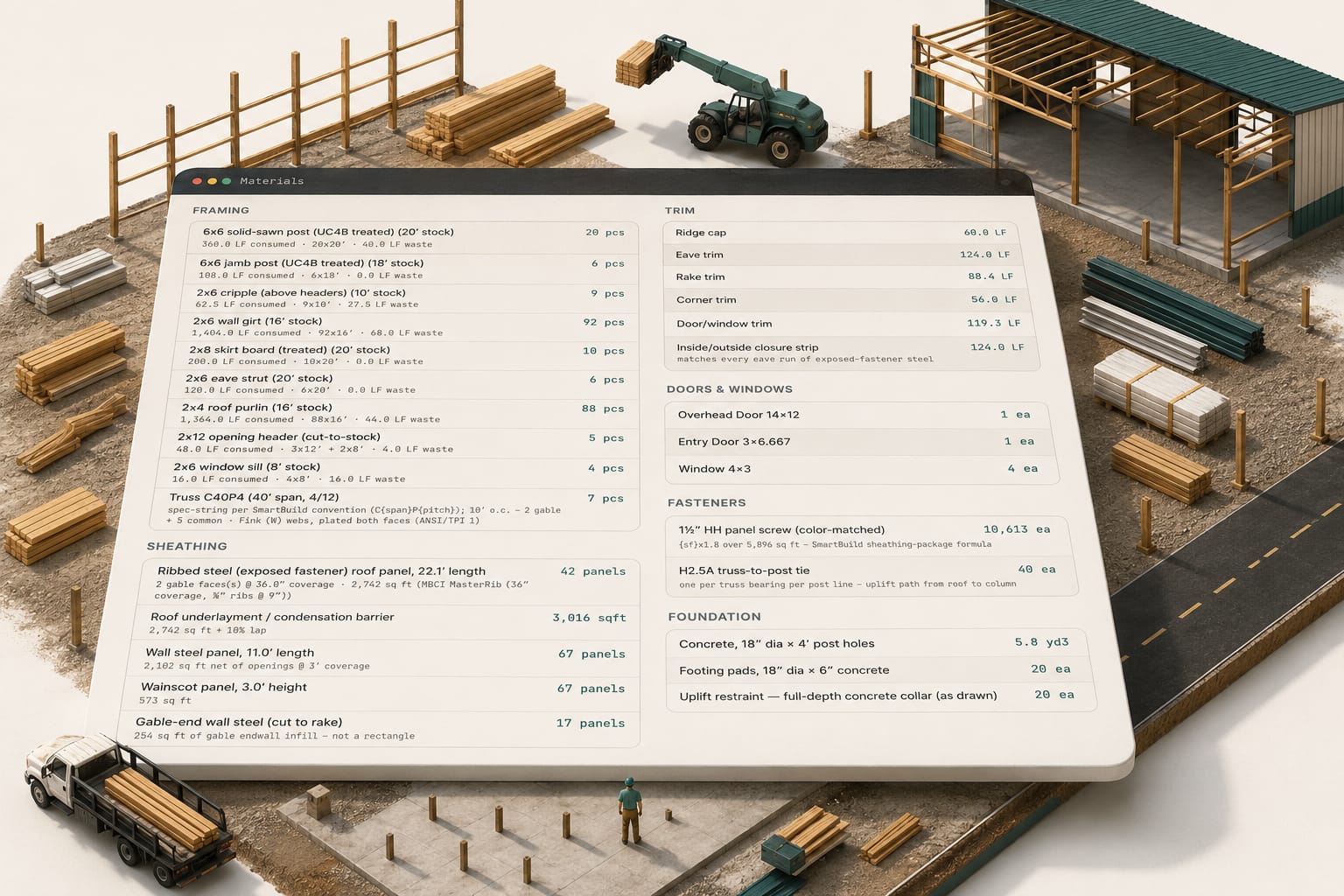
Post frame has an advantage most trades don't: the material list is a function of the geometry. Posts follow from spacing and length; trusses from span and pitch; girts and purlins from spacing; panels from area and cut length; trim from every edge and opening; fasteners from panel count.
That's a calculation, not a memory. Doing it from memory is where the two-truss error and the forgotten trim run come from — and neither shows up until the delivery.
If you take one thing from this: the estimate should be re-derivable. If a customer moves a door and you can't reproduce the number without starting over, you don't have a bidding process, you have a document.
We compared the three kinds of tool for exactly this — takeoff, catalog, and geometry — with real pricing here. The template and its limits covers the spreadsheet version honestly.
Deriving beats recalling because memory does not update when the building changes. A takeoff produced from the model recounts every stick, sheet and screw the moment the span or the pitch moves.
Step 4 — Price the work by stage
Hours are how you think; stages are what customers buy and what your crew delivers. Price site prep, concrete, post set, framing, roof steel, wall steel, doors and trim, and finish — each as a line.
Two rules that pay for themselves:
- Use your own history, not a rule of thumb. If you've been logging stage durations, you already know your real post-set day for a 40×60. That number is worth more than any published average, and it is the same number that decides what the crew takes home when the build comes in under the days you figured.
- Price equipment as its own line. Crane and lift days hide inside "framing" and disappear from the analysis afterwards.
Step 5 — Add overhead and margin as rates, out loud
Overhead is not padding — it's the truck, the insurance, the phone, the office, and the hours nobody bills for. Calculate it as a percentage of your annual costs against your annual revenue, and apply it as a rate.
Then margin, separately, as a rate. When they're blended into the line items, a discount conversation eats your margin without anyone deciding to give it away.
Step 6 — The pre-send checklist
Six questions. If any answer is uncomfortable, the bid isn't ready:
- Could I rebuild this number from scratch and land within 2%?
- Is every exclusion written down?
- Does the schedule in this bid account for weather days in this month?
- Is the steel price current, and does the bid state how long it holds?
- Is my margin a stated rate, or is it whatever's left?
- If they ask for one change, how long does re-pricing take?
That last one predicts more about your year than the number itself.
What to refuse
- Bids against a number you can't see. "Beat this quote" is a race with an invisible opponent, usually one who excluded half the scope.
- Work outside your build type. The most expensive job most post-frame builders ever take is the one that wasn't post frame.
- Sites you haven't seen — above a threshold you set and keep.
Steps 2 and 3 are the ones software can take off your evening: construction estimating software built exclusively for post-frame and barndominium builders has you draw the building in 3D and counts every stick, sheet and screw as you go.
Knowing the number was right
You don't find out at the bid. You find out at the end, and only if you closed the loop: actual materials against estimated, actual stage days against planned, change orders separated out. Three jobs of that and your bidding stops being an opinion.
That loop is the whole argument for having the estimate, the schedule and the invoice in one system rather than three — the comparison is automatic instead of an evening's reconciliation. Here's how ours runs.
For post-frame engineering references — spans, loading, embedment — the National Frame Building Association is the trade's own source, and worth reading before you finalise your assumptions.
One open loop: a correct bid still loses to a fast one surprisingly often. The proposal that carries the number does more of the winning than the number does.