A construction proposal is not an estimate with a nicer font. The estimate is arithmetic; the proposal is the argument. It has to answer a question the customer will never ask out loud: can I trust this person with eighty thousand dollars and four months of my life?
Here's what a post-frame proposal has to contain, what to deliberately leave out, and why the fastest proposal beats the cheapest one more often than builders expect.
What the customer is actually deciding
By the time you're sending a proposal, the customer has usually collected two or three. They cannot evaluate your framing schedule. They can't tell a good truss spec from a bad one. So they decide on the things they can judge:
- Did this person understand what I asked for?
- Do I know exactly what I'm getting and what I'm not?
- Does the money make sense, and is it predictable?
- Did they show up when they said they would — starting with this document?
Every section below exists to answer one of those. Anything that answers none of them is padding, and padding reads as uncertainty.
The template
| Section | What it does |
|---|---|
| The building, in one line | "40×60 × 14′ shop, 4/12 pitch, one 12′ lean-to, two 10×10 overhead doors." Proves you listened |
| A picture of it | A render, a model, even a marked-up sketch. This single item moves more deals than any paragraph |
| What's included | Every stage, in build order, in plain words |
| What's not included | Site access, fill, electrical, plumbing, final grade, permits if they're pulling them |
| The number | One total. Then the breakdown beneath it |
| Payment schedule | Deposit and draws tied to stages, with what each one buys |
| Timeline | Start window, stage durations, completion range — and say the word "weather" |
| What happens if something changes | One sentence on change orders. Sets the tone before it matters |
| Who's doing the work | Your crew, your years, one or two builds like theirs |
| How to say yes | One clear action. Not "let me know" |
| Validity | "Holds for 30 days." Steel moves, and a deadline is a decision-forcing gift |
The three things to leave out
Your life story. Two sentences of credibility beat two paragraphs. The customer is scanning for competence, not biography.
Hedged language. "Approximately," "we'll try to," "should be around" — each one transfers risk to the reader and reads as a builder who isn't sure. Say a number, or say what it depends on and what it would cost.
Every possible option. A proposal with three packages and eleven upgrades is a homework assignment. Recommend one building, list at most two clearly-priced upgrades, and let the conversation do the rest.
Speed beats price more often than you'd think
The pattern is consistent across trades: the builder who gets a complete, clear proposal in front of the customer first wins a disproportionate share of the work — not because they're cheapest, but because they're the only concrete thing on the table while the customer is still excited.
Two days is usually the difference. Not two weeks.
The practical consequence: whatever produces your proposal has to be fast enough to use while the enthusiasm is still warm. If assembling one means a night of copying numbers between a spreadsheet, a Word template and a PDF, you will send it on Thursday, and Thursday is often too late.
The signature is part of the document
A proposal that requires printing, signing, scanning and emailing back adds days — and days are where deals die. Not because the customer changes their mind, but because life intervenes and momentum leaks.
If there's one change worth making to how you send proposals, it's this: make it signable where it's read. It costs nothing and it recovers deals you never knew you were losing.
Where ours differs, plainly
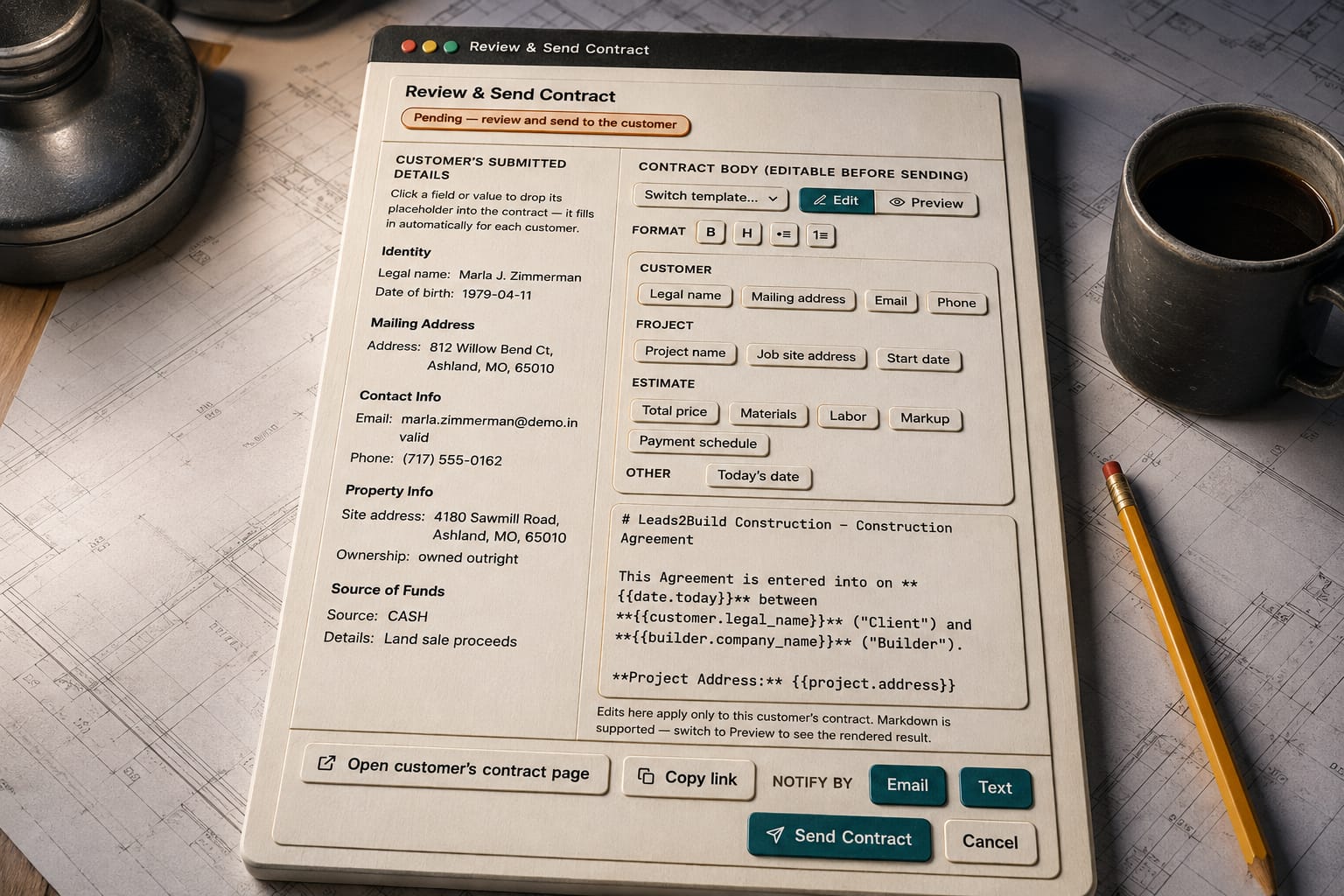
We built the proposal as a live link rather than a document: the building is modelled in 3D so the customer can see the thing they're buying, the price re-derives if they ask for a change while you're on the call, and accepting it signs the agreement and takes the deposit in the same place. It becomes the contract and the draw schedule without anyone retyping a figure. Here's the whole path, and what the customer sees.
If a template and a PDF are winning you the work you want, keep them. Move when the delay between "we'll get you a number" and "here's the number" starts costing you jobs.
The difference worth naming is the format. Ours is a page the customer opens, not a PDF they download — their building in 3D, the price broken down, and an approval that starts the job at the bottom of the same page.
The page, the approval and the contract only stay in step when they share a record; in a construction CRM built exclusively for post-frame and barndominium builders the building, the quote, the contract and the customer's link are one.
Send this one differently
Take your next proposal and do three things: add the exclusions section, add a picture of the building, and cut every hedge word. Then send it the same day.
It's the cheapest experiment in your business, and the result usually shows up within a month.
For the underlying estimate that feeds it, here's the template and its limits. For the standards and contract references the industry leans on, the National Frame Building Association and AIA's contract documents are both worth knowing before you write your own terms.
One open loop: the proposal wins the job, and then the job has to be run. Everything that decides whether it stays profitable happens after the signature — the schedule, the changes, the draws — and none of it is in this document.