Ask a pole barn builder how the last crew app went and you'll usually get the same story. It worked for about a week. Then the passwords got forgotten, the photos went back into the group text, and somebody started writing hours on the back of a lumber ticket again. The conclusion everyone draws is that crews won't use apps.
That's not quite it. Your crew uses apps all day — weather, maps, the bank, the group chat. What they quit is apps that are hard to use with gloves on and that only ever take from them: their hours, their photos, their check-ins. A tool that takes and never gives back is a chore, and chores get skipped the moment the boss stops watching.
So if you're picking a crew app for pole barn builders, two questions matter more than the feature list. Can a man use it without feeling stupid? And what does he get out of it?
Nobody wants to look slow in front of the crew
Think about a new framer on his second day. He doesn't know the crew, he doesn't know your yard, and now there's an app. If clocking in means finding a menu, picking a job from a dropdown and typing a password he set on Monday, he has two options: ask the leader in front of everybody, or skip it and guess his hours later. Most men skip it.
The fix is boring and it works. One link on his phone — no account, nothing to install. It opens on the job he's standing on, with the clock as the biggest thing on the screen and only two other buttons: one for a photo, one to say he's stuck. Black on white, because grey disappears in the sun. Buttons big enough to hit with a glove on. When there's nothing to learn, there's nothing to be embarrassed about.
It also has to work where the work is. Plenty of sites run on one bar, and once the panels go on a steel building what's left drops again. If a clock-in or a photo can fail and vanish, the man who tapped it gets blamed for a missing day. A field app worth having saves the tap on the phone, sends it when the signal comes back, and says so in plain words.
That record isn't only his problem. In the US, the Wage and Hour Division requires an employer to keep the hours worked each day and the total for each workweek for every non-exempt man on the payroll. Hours rebuilt on Friday from memory and a lumber ticket are not that record. Two real taps are.
Every app on the jobsite takes. Very few give anything back
Here's the part most field software skips. You're asking every man to hand over data every day. What does he get back?
Usually nothing. His hours disappear into payroll, his photos into a folder he'll never see. If the crew finishes two days early, maybe there's a bonus, maybe there isn't, and nobody can say how it was worked out. From where he stands, the app is just the office checking up on him.
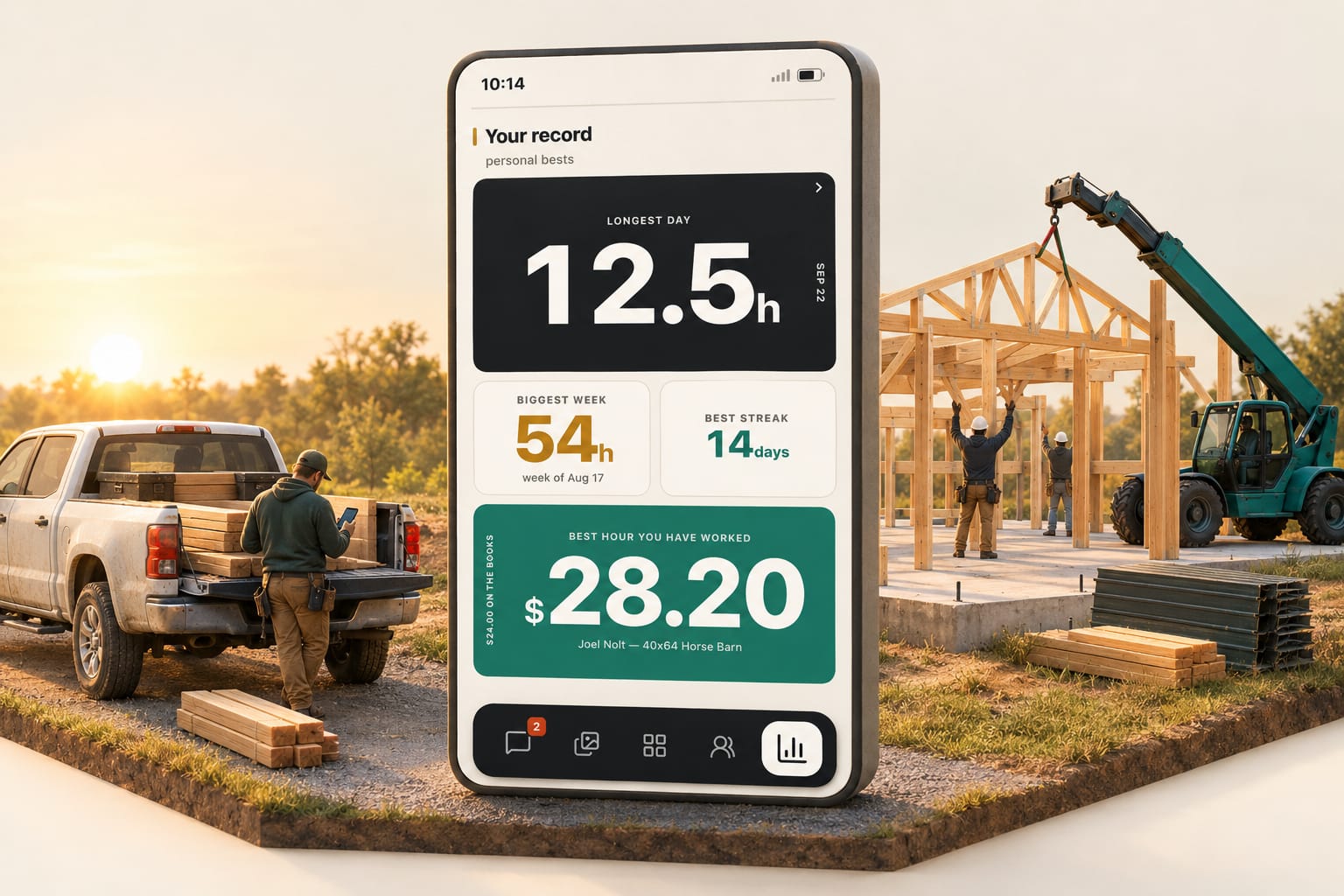
Now turn that around. What if the same app showed him his own record? The hours he's put in since he started. His longest day, his biggest week, the days in a row he's turned up. That's not surveillance anymore. That's a scoreboard, and it's his.
This isn't a soft idea, and it needs no study behind it. A framer already keeps score in his head: he knows which crew he'd rather be on, and roughly what he's worth to you. What he doesn't have is the record. Give it to him and the score stops being an argument. It turns into a fact he can check, and beat. A good hand who can watch his own growth at your outfit thinks twice before leaving for a dollar more down the road.
Money he can see is money that motivates
The strongest version of this is pay. If you share a surplus when the crew beats the days a job was figured for, the crew should be able to see exactly what that did for them — not as a rumour, but as a sum. Which reward actually moves a crew is its own argument.
The cleanest way to show it is the hourly rate the job actually came to. Say a man's rate is $24 an hour. He put 142 hours into a 40×64 horse barn, and his share of what the crew saved by finishing early was $596. That job paid him $28.20 an hour. When he can see that on his own phone, finishing early stops being a nice idea and starts being a number he's chasing.
It works for you too: a crew that can see the payoff pushes to beat the days instead of filling them. If you pay this way, hourly pay with a shared surplus explains the budget, the split and the shortfalls.
People need to feel heard, too
There's one more thing crews almost never get: a quiet way to say something. A man working next to someone unsafe can say it in front of everyone or say nothing, and both are bad for you.
A good crew app gives him a third option: tell the office, with the facts, and the person it's about never sees it. Just as important, the same box takes praise. When a man can write "came back after his own pour to help us set the last trusses," the office starts hearing about the people who quietly carry the job.
What this looks like in Leads 2 Build
Leads 2 Build is the operating system built exclusively for post-frame and barndominium builders, and the crew app is where that shows most. The checklist on a framing crew's phone says Post Set, Girts Done and Trusses Up. A concrete crew only ever sees the slab. Hours, photos and hold-ups land on the right job and stage without anyone filing them.
Each man gets one link from his crew card, and the card tells you when he opened it. He clocks in with one tap, and a photo files itself against the right job and stage as he walks, which is what turns a checkpoint into a photo instead of a checkbox. New jobs wait on his phone until he taps Accept, so nobody can say they never saw it. Behind the Hours door is his own record: his time, his bests, what he's been paid and what each hour came to, worked out in front of him. The punch clock itself is covered on its own page.
The one-minute test before you buy
The real question is whether your guys would open it on a day you weren't watching. Five things to check:
- Hand it to your newest man. If he clocks in without asking how, it passes.
- Tap the clock in airplane mode. Put the signal back on and check the tap survived.
- Open the Hours door yourself. If there's nothing behind it for him, the app only takes.
- Ask a man what the last job paid him an hour. If he can't find it, he can't chase it.
- Find out who reads the reports. A box nobody empties is worse than none.
Here's where this stops. If a man carries no smartphone, the link has nowhere to land and his leader clocks him in and out — the old problem in a new coat of paint. A crew app can make the record honest for every man with a phone in his pocket. It can't put one there.