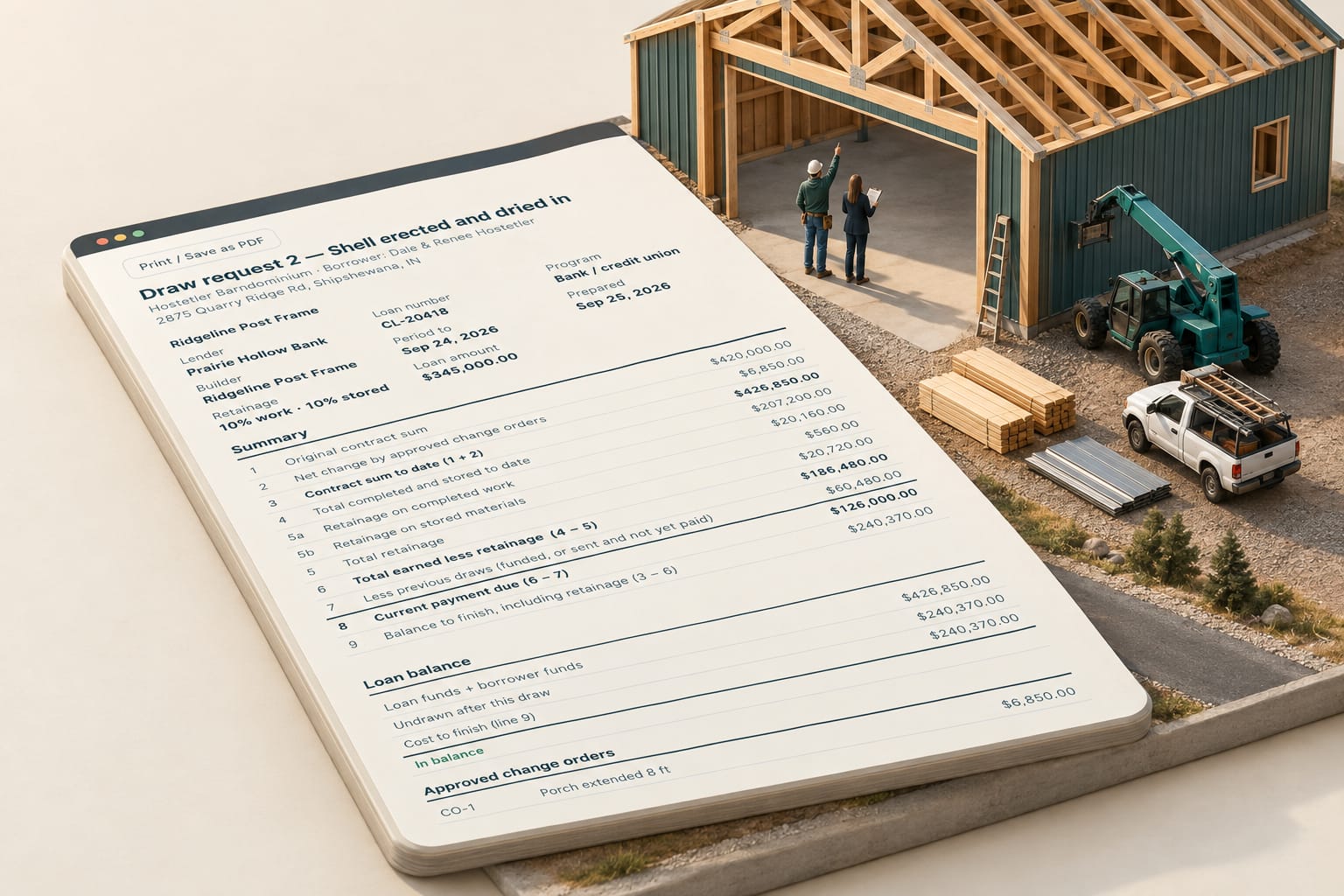
Most barndominiums are built on somebody else's money. The buyer closes a construction loan, the bank holds the funds, and you get paid in pieces — a draw for the site work, a draw when the shell is dried in, a draw for the rough-ins. Every piece waits on a barndominium draw request: your proof the stage is done. Send one a lender can check without phoning you and it funds. Send one with a gap and your money waits while the emails go back and forth.
The gap is rarely the work. The trusses are up. The steel is on. What's missing is the package. The photos are on the foreman's phone, the lien waiver is in somebody's inbox, the county's framing slip is on the dash of the truck, and the percentages are in a spreadsheet typed the night before. The bank asks for one thing, you send it, and it asks for the next. A week goes by. Your crew's payroll doesn't.
Here is what a lender checks, the five parts it expects, and how to have all five ready the day the last checkpoint is ticked.
A bank pays for proof, not for progress
A loan officer isn't trying to slow you down. They're paid to make sure the bank never pays ahead of the work, and their examiners check that. The FDIC's examination procedures for construction lending list the controls supervisors look for: on-site inspections, disbursement as work progresses, lien waivers from subcontractors before money goes out, a portion of the proceeds retained until the work is satisfactorily complete, and comparisons of draws to the degree of completion.
So the package is predictable. Five parts:
- A summary page. The original contract, approved change orders, work completed and stored to date, retainage, what earlier draws paid, and the amount due now. Lenders know it by its form number, G702; the AIA's own summary of that document describes the same lines.
- A continuation sheet. One row per part of the job — scheduled value, what earlier draws covered, what this period covers, materials stored on site, balance to finish. That's the G703, which breaks the contract sum into a schedule of values.
- Lien waivers. A conditional waiver for the draw you're claiming, an unconditional one for the draw already paid. Several states set the wording by statute and won't enforce a waiver that doesn't substantially match their form, so use your state's version, not a generic one.
- Evidence. Dated photos of the stage being claimed, plus the county's slip for the stages that get inspected — footings, framing, rough-ins.
- The borrower's sign-off. It's their loan. Most lenders want the buyer to approve a draw before money moves.
When all five arrive together, in the order the lender reads them, the draw gets funded. When they arrive one email at a time, somebody picks up the phone.
The percentage is where trust is won or lost
The hardest line on any draw is "percent complete." Builders estimate it from memory at the end of a long week; the inspector estimates it walking the site. When the two disagree — you claimed 75% on framing, the inspector saw 60% — the bank doesn't split the difference. It pays the inspector's number and reads your next draw more carefully.
The fix isn't to claim less. It's to claim from something you can both check. If every stage carries a checklist — posts set and plumbed, girts on, trusses set and braced, purlins run, framing inspection passed — then percent complete stops being a guess and becomes a count. Four of six checkpoints is 67%, and the inspector can walk the site with the same list in hand. Stage checkpoints work best when each one carries its photo instead of a tick.
And when the work really is ahead of the checklist — real jobs have work no list itemises — say so before the inspector does. A claim that runs ahead, flagged by you, reads as honesty. The same claim found by the inspector reads as front-loading. One builder gets the benefit of the doubt for the rest of the loan; the other gets every draw checked twice.
Stop assembling the package the week it's due
Because the package is predictable, it can be collected while the job runs instead of rounded up at the end. The photos are already being taken; they need a date, a stage and a location on them. The waivers are already being signed; they need a home tied to the draw they cover. The inspections already happen; the slip needs filing against its stage. Do that, and the day the last checkpoint is ticked the draw is ready — not a week later.
Two habits keep the money moving:
- Freeze what you send. Once a draw goes to the bank, nothing in it should change. Money disputes start with "that's not what you sent us," and a package that can't be edited after it leaves ends that argument before it starts. It's the same discipline as billing the draw you agreed to, not the one you remember on a cash job.
- Watch the balance before the bank does. Every upgrade the buyer approves makes the contract bigger, but the loan doesn't grow by itself. Price change orders into the total as they're signed and you can see whether the money left — undrawn loan plus the borrower's own cash — still covers the cost to finish. Better to learn that the week the upgrade is signed than at the final draw with the drywall half hung.
The bank stops calling when it has its own page
Leads 2 Build works only with post-frame and barndominium builders, so a draw's checklist is built from the stages those builders already run. The rows the job can answer tick themselves; the paperwork rows wait for an upload. When the last is in, the draw leaves as one sealed package — summary, continuation sheet, waivers, and photos with time and location on each.
The bank works that draw on its own page for the loan, with no login, and you hear each decision as it happens instead of reading it in your balance days later. Who gets which link, and what a lender can see, is laid out there.
Loan officers move fastest on files that look like the ones they already trust. Give them a familiar package, numbers they can verify against the job, and a page where nothing is asked for twice, and the draw stops sitting on a desk waiting for the next email. Your crew gets paid on time, and the next barndominium buyer who walks into that bank asks who built the last one.
The sixty-second check before you send
- Does the summary show contract, change orders, completed and stored, retainage, previous draws and the amount due — in that order?
- Can you defend every percent on the continuation sheet from a checklist, not a memory?
- Is the conditional waiver for this draw attached, and the unconditional one for the last?
- Is there a dated photo for every stage claimed, plus the slip for the ones that get inspected?
- Has the borrower approved it, and does the undrawn loan plus their cash still cover the cost to finish?
- Is anything claimed ahead of the checklist flagged by you, instead of left for the inspector?
A draw returned for one missing line costs more days than the line was ever worth.
What none of this changes is the bank's own clock. A complete package moves you to the front of the queue; it doesn't shorten the queue. Some lenders won't approve until a title update clears, others fund on a set run whatever day your draw landed, and no software reaches inside either. A clean barndominium draw request buys the days you control, not the ones the bank controls.