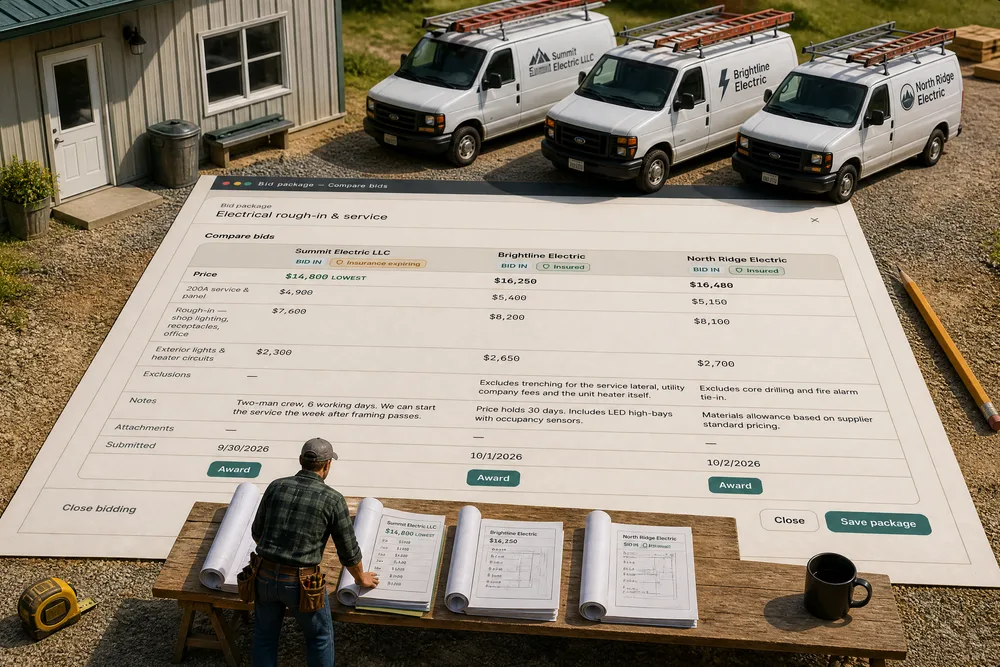
A bid package on the job's Subcontracts card: a title, the cost code and schedule stage, the scope every bidder prices in the same words, the drawings and a due date. Invite subs — each one's insurance badge shows as you pick — and each gets their own no-login link to submit one price or a line breakdown, their exclusions, notes and their own quote, and to revise until you award, or to decline. Compare bids lines the subs up in columns with the lowest marked; Award raises the subcontract PO as a draft with the scope and the winning price, and everyone else sees not awarded on their link. We don't build software for plumbers or remodelers — only for builders like you, who bid the plumbing out.
Also called: bid package · invitation to bid · sub bids · bid leveling · compare subcontractor quotes · request for bids · subcontractor bids
One scope, written once, for every bidder
A bid package holds the title, the cost code / trade, the schedule stage, bids due, the scope of work and the drawings. Electrical rough-in & service on the Dawson Hoover shop covers the 200A service, the high-bays, receptacles every 12' and the unit-heater circuit — the same words for every electrician, due Oct 7, 2026.
Three electricians price three different jobs because each got a different description over the phone.
Subs bid sharper when they all read the same scope — and the project manager can finally compare like with like. Writing it once also means nobody retells it four times.
Invite subs — each one gets their own link
Try itInvite subs adds bidders from your contractors and suppliers, each with their insurance badge beside the name — Summit Electric LLC · Insurance expiring, Brightline Electric · Insured. Send invites emails each sub their own link; for a sub with no email you get a link to copy. Here: 2 of 2 invites emailed.
Sending the same scope to four subs means four emails, four attachments and no idea who's opened it.
One send replaces a morning of emails, and the project manager sees each sub's insurance before inviting them. A link per sub means every bid comes back attached to the right sub.
Subs price it from a link — one number or a breakdown
Try itThe sub opens their link — no login — reads the scope and drawings and prices it: One price, or Break it down into lines that add themselves up. Then Exclusions, their own quote or drawings, notes and their name — Submit bid, or Can't bid. Summit breaks its $14,800 into the service, the rough-in and the exterior circuits.
Bids come back as a number in a text, a PDF in an email and a voicemail — none of them on the same terms.
A sub can bid from his truck in five minutes, so more of them actually bid. Exclusions in their own box is what stops a cheap bid hiding the work it left out.
You hear about every bid as it lands
Each bid raises Sub submitted a bid for admins and project managers: Summit Electric LLC bid $14,800.00 on Electrical rough-in & service — Compare it with the other bids in the project's Subcontracts card. A revised bid says it replaces their earlier number.
Bids arrive at night by text and sit unread until you're on site the next afternoon.
The price reaches the person who decides, with the place to compare it. Fast awards keep good subs from booking the week somewhere else.
Subs can sharpen their number until you award
After sending, the sub's link shows Your bid — the price, the breakdown, the notes and Submitted by Dale Summers on Sep 30, 2026 — with Revise your bid while the package is open. A revision replaces their earlier number.
A sub wants to sharpen his price and has to start a fresh email chain to do it.
One bid per sub, always the latest — the project manager never compares against a stale number. The sub keeps his own record of what he sent.
Compare the bids side by side — exclusions included
Compare bids gives each sub a column: their status and insurance badge, the price with the lowest marked, each line of a breakdown, exclusions, notes, attachments and when they submitted. Summit is $14,800 — lowest; Brightline is $16,250 and excludes trenching for the service lateral, utility company fees and the unit heater itself.
The lowest number wins — until you find out it left out the trenching and the utility fees.
The owner sees what each price leaves out before he commits, so the cheapest bid is the cheapest job. The same rows for every sub is what levels the bids.
Award one — the PO writes itself
Award says what it will do before it does it: a draft subcontract PO for $14,800 is raised with this scope and their line breakdown, plus the stage and the drawings, and the PO's internal memo records the package and the bid it came from. The subcontract PO opens ready to check and send.
The winning number gets retyped into a PO by hand and comes out different.
The number the sub bid is the number on the PO, because nobody retyped it. The project manager goes straight from deciding to sending.
Awarding a sub with lapsed insurance warns you first
If the sub's required insurance is missing or expired, the award says so before the PO is raised: Insurance: Workers' comp expired Sep 13, 2026 — and, with the payment hold on, that payments to this sub will be on hold until a current certificate is on file. You can still award; you just do it knowing. See sub insurance.
You award the cheapest plumber and find out at the first payment that his comp lapsed.
The warning lands while choosing the next bidder still costs nothing. Nobody is surprised by a held payment three weeks later.
The subs who lost see it on their link
Awarding marks every other open bid not awarded. Their link now reads This package was awarded to another bidder. Thank you for bidding., above their own bid.
Subs who lose never hear back — so next time you ask, they don't bother bidding.
A sub who gets an answer bids again. Closing the loop costs the office nothing and keeps your bench of subs deep.
What's out to bid shows on the job
Each package sits on the job's Subcontracts card with its status, how many bids are in, the due date and the lowest so far — Electrical rough-in & service · Out to bid · 2 of 2 bids in · Lowest $14,800. Closed, the card says 1 out to bid · 2 bids in.
Which trades are still out to bid is something only the estimator knows.
Anyone opening the job sees what's waiting on a price, so a stage never sneaks up on a trade nobody awarded. It lives where the job's other subs live.
A sub who can't bid tells you in one tap
Can't bid lets a sub decline with a line for you — Booked solid through November — ask us next time. — and the package shows them as declined, so you stop waiting on a price that isn't coming.
A sub who can't bid just goes quiet, and you wait on a price that's never coming.
A fast no lets the project manager invite someone else while there's still time. Making it one tap is what makes subs actually send it.
- 1On the job's Subcontracts card press Bid package: title, cost code, schedule stage, scope, drawings, bids due.
- 2Invite subs — pick them (their insurance badge shows) and Send invites; each gets their own link, or you get a link to copy when there's no email.
- 3Subs submit or revise their price from the link — one number or a breakdown, with exclusions, notes and their own quote — or decline.
- 4You're notified of every bid; the card shows how many are in and the lowest so far.
- 5Compare bids: the price with the lowest marked, line breakdowns, exclusions, notes, attachments and insurance, side by side.
- 6Award one: a draft subcontract PO is raised with the scope, the price or lines, the stage and the drawings, and the others are marked not awarded. Awarding a sub whose insurance is missing or expired warns you first.
Bids came in by phone, text and email in different shapes — a number here, a PDF there, a 'call me' — so they never sat side by side, and the cheap one sometimes left half the job out. The subs who lost never heard back, and awarding meant retyping the winner's number into a PO. So every sub now prices the same scope on the same page, exclusions included, the bids line up in one table, and the award writes the PO.
- Sub bids scattered across phone, text and email
- Bids on different scopes that can't be compared
- Exclusions found after the award
- Winning number retyped into a PO by hand
- Losing bidders left waiting