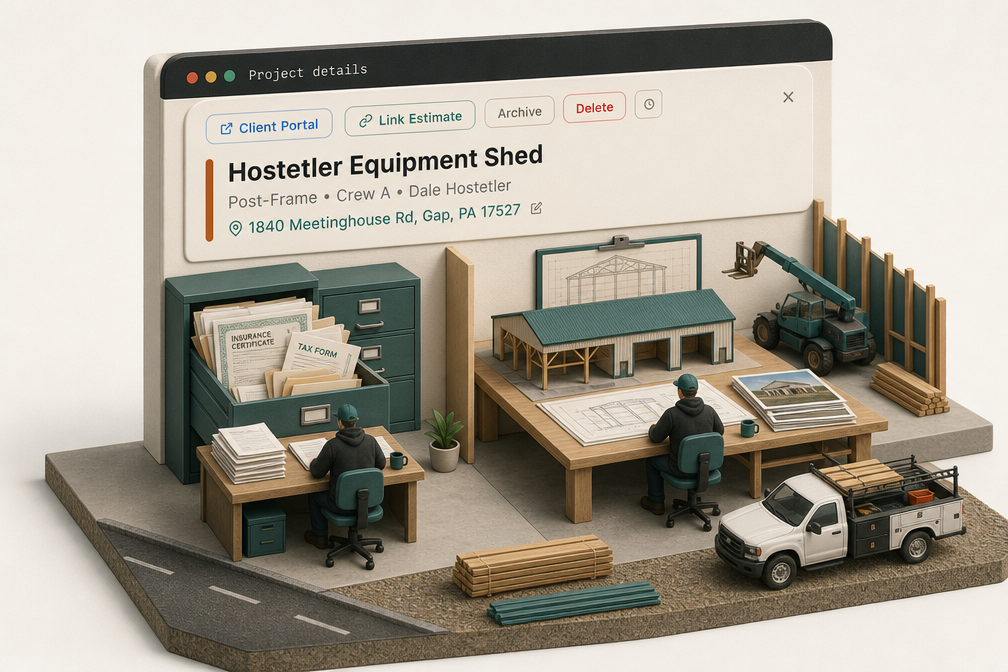
A contractor management solution is one of two products, and the search results mix them: software for managing the contractors you hire — W-9s, certificates of insurance, classification, payment — and software for running a contracting business — leads, quotes, contracts, schedules, change orders, invoices, crews. One builder is trying to stop losing $14,000 draws in a spreadsheet; another is trying to prove his framing sub carried insurance the day the roof went on. A post-frame builder with his own crews and a handful of regular subs needs the second product, and the first will sell him a solution to a problem he does not have yet.
Which of the two meanings did you mean?
Sense one: managing the contractors you hire. Onboarding subs and 1099 workers, collecting W-9s, tracking certificates of insurance and their expiry dates, classifying people correctly and paying them. Workday and ADP rank for this and are genuinely strong at it, at the scale of a company with a compliance department. The IRS rules on independent contractor versus employee deserve one careful read even if you never buy software for it.
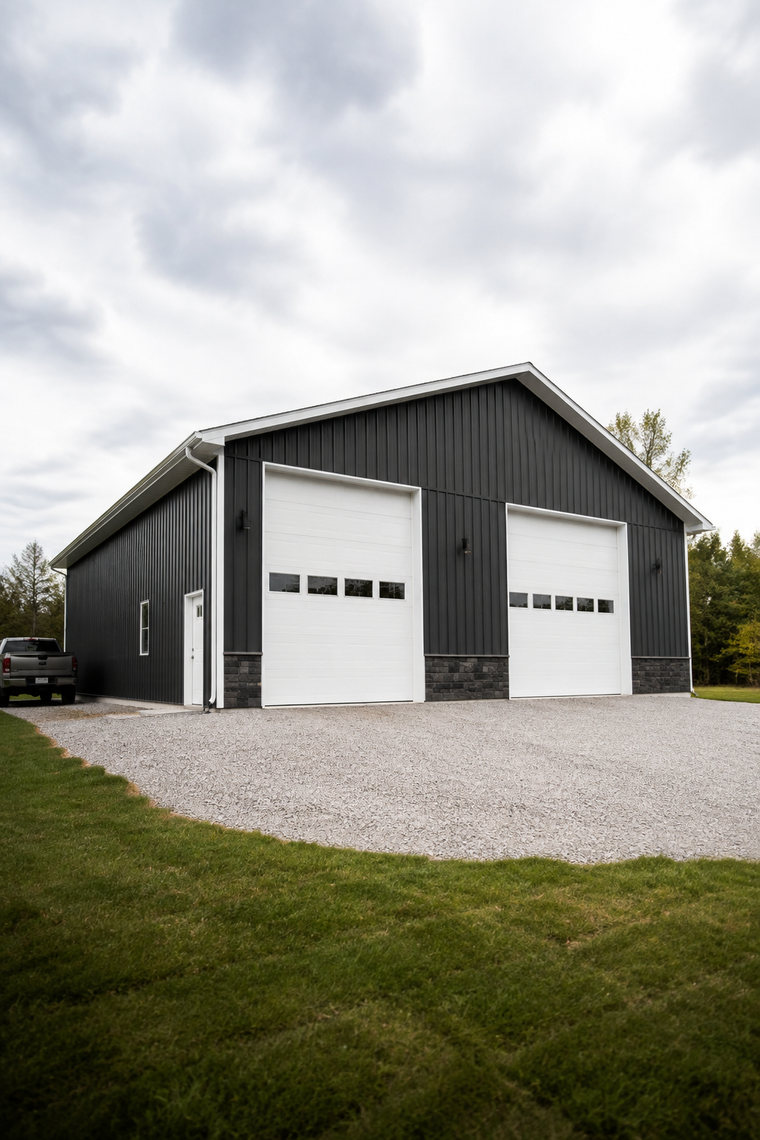
Sense two: software for running a contracting business. This is what Buildertrend, Contractor Foreman, JobTread and the rest of that shelf mean by the phrase, and almost certainly what you meant. If you build post-frame — shops, arenas, equipment storage, barndominiums — with your own crews, you are here.
What six jobs does it have to do?
Six jobs, and every one is a place a deal leaks.
1. Hold every lead until someone kills it or closes it. A quote for a 40x60 shop is worth nothing if it sits nine days because following up was nobody's actual job. The pipeline is the cheapest of the six to get right and the most commonly skipped. On the Sales Pipeline Board every lead carries its own timeline — how long it has sat, in which stage, which steps were done — so nine days is a number on the card, not a feeling.
2. Produce a number you can defend. Post-frame pricing runs off geometry: stretch the building ten feet and five quantities move together whether or not anyone remembers. Software that treats a building as a list you type lets those quantities drift — the long version is the builder's short list of estimating software.
3. Turn a yes into a signature and a deposit the same day. If saying yes means printing, signing, scanning and mailing back, you lose deals in that gap that had nothing wrong with them. The customer signs the agreement on the phone already in their hand — a drawn signature, no account, no printer.
4. Schedule crews against weather that does not cooperate. A schedule built on fixed dates is wrong by the second rain; stage-based scheduling with honest buffers is the version that survives — covered here.
5. Make every change a priced, signed document. The customer decides mid-build they want the 12-foot lean-to after all; everyone agrees in the driveway. If that never becomes a document, the margin is gone and nobody can say when. It is the most expensive habit in the trade, with its own playbook. Change orders the customer can read appear on their own page with the cost, the schedule impact and a signature block.
6. Bill from the same numbers everywhere. If the invoice is retyped from the estimate the two quietly disagree, and you find out during reconciliation — what invoicing has to handle is its own post.
A tool that does four of these and leaves two to a spreadsheet means you run two systems and pay the handoff cost between them.
Which product fits which builder?
The useful question is fit, and prices are deliberately not printed, because a stale number is worse than none.
Repeatable visits and price-sheet quoting: Jobber is easy to adopt and covers quoting, scheduling, invoicing and payments; businesses outgrow it when the work becomes a six-week build with draws and stages. Maximum coverage per dollar: Contractor Foreman is remarkable for breadth at the low end and suits small general contractors who want one affordable tool touching everything. Cost control from a catalog: JobTread is a budget-and-job-costing spine with transparent pricing, and builders who maintain their own item libraries do well on it. A real back office building custom homes: Buildertrend is the most mature residential suite — selections, budgets, client portal, financing — built for a company with someone whose job is the system. The HR sense: Workday and ADP are excellent at classification, onboarding and payment at scale, and are not job-management tools. Post-frame buildings where the quote is the geometry: the case we built for.
Where do the six jobs become one record?
For a post-frame builder the estimate is not a document you produce; it is the shape of the building. The building is modelled in 3D where the customer can see it, and the material list derives from the geometry against a real supplier catalogue — move the overhead door and every dependent line moves. The customer approves on a page with no password, answers a questionnaire that fills their contract, signs, and pays a deposit. Stages drive the schedule, changes become signed documents, and draw invoices push to QuickBooks so the books and the job agree. All of it sits on one screen per job — the project cockpit: stages, crew, the money, the documents, and what the customer is seeing right now. That whole picture is Project Command.
What should you ask on any demo?
Run this on any demo, ours included. "Model my last building — 40×60, 14-foot walls, a 12-foot lean-to, two overhead doors." "Now move a door; show me what changes in the material list and the price." "Show me the change order document the customer signs," not the notes field. "Show me a draw invoice and tell me where those numbers came from" — if the answer involves retyping, you have found next year's discrepancy. And "how many other tools will I still be running after this?" — that number is the real price.
One thing we do not do, stated plainly: we do not track subcontractor certificates of insurance, W-9s or expiry dates. If you carry real compliance exposure across a bench of subs, that is the first sense of the phrase and it lives in a different product. For the standards side of the trade, the National Frame Building Association is the industry's home base. We may build the compliance piece one day; today it would be a promise, not a feature.