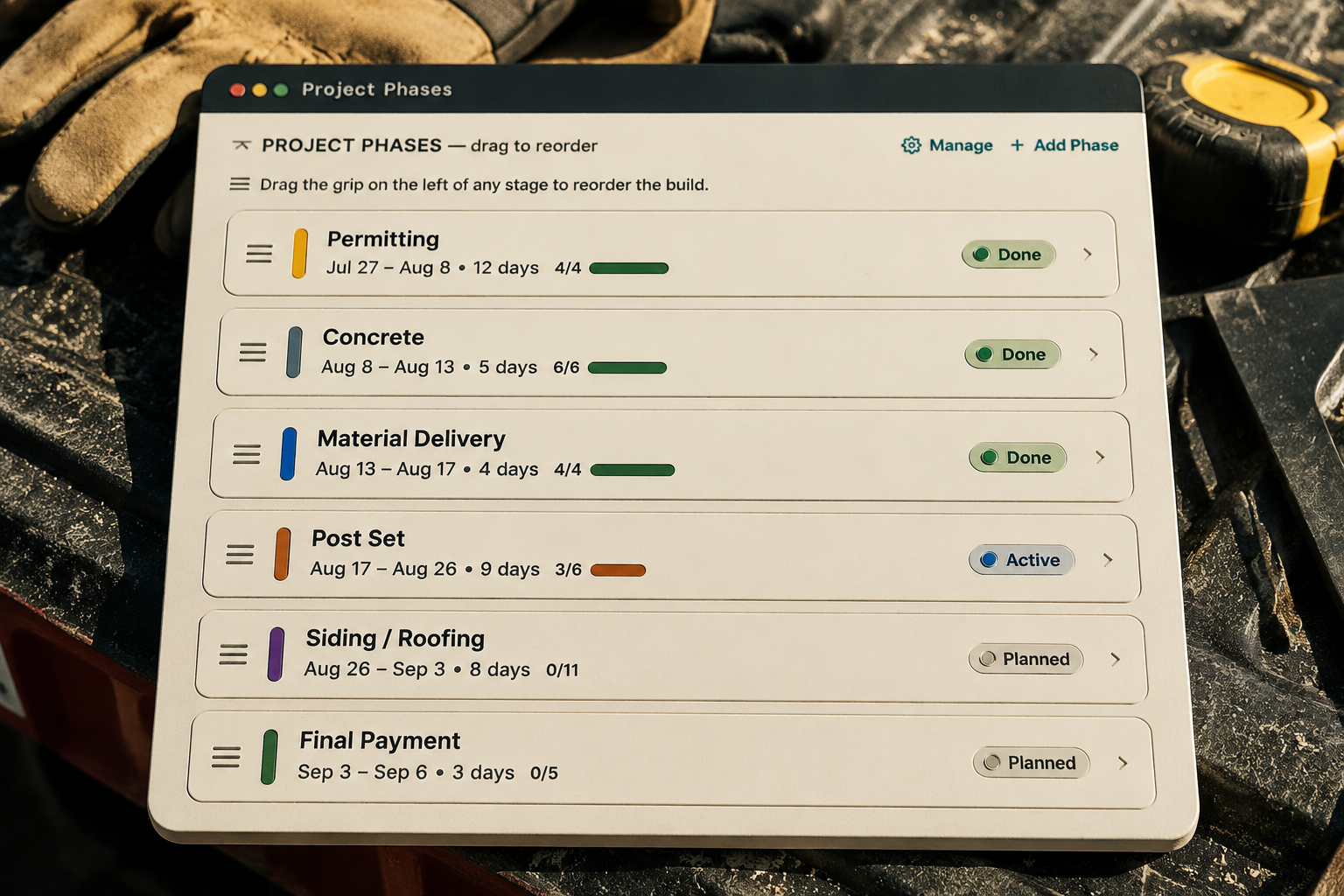
A stage in contractor management software is a phase of the build that owns four things: a name your crew uses, a length in working days, the crew that does it, and a checklist that has to be ticked before it is over. If the stage list that comes with the software reads Foundation, Framing, Roofing, it was written for a stick-built house, and your crew lead will stop using it by the second job.
What a stage is, in four parts
| Part | What it holds | What breaks without it |
|---|---|---|
| Name | The phase as the trade says it: Post Set, not Foundation | The crew keeps a second list in their heads |
| Length | Working days, counted in the days that crew works | A five-day stage runs through a weekend on paper |
| Crew | The crew or sub that owns it, one per stage | Two crews think Roof Steel is theirs next Tuesday |
| Checkpoints | The steps inside it, ticked as they are done | "Done" means whatever the last person said |
A stage is therefore not a calendar block. A block has a start and an end. A stage has a state, and it changes state when the work inside it is finished, which is a different thing from the date arriving. The whole category is defined by that difference, as what contractor management software actually runs on a 40x60 sets out: the job is one record, and a stage is the unit that record advances in.
Why post-frame needs its own stage list
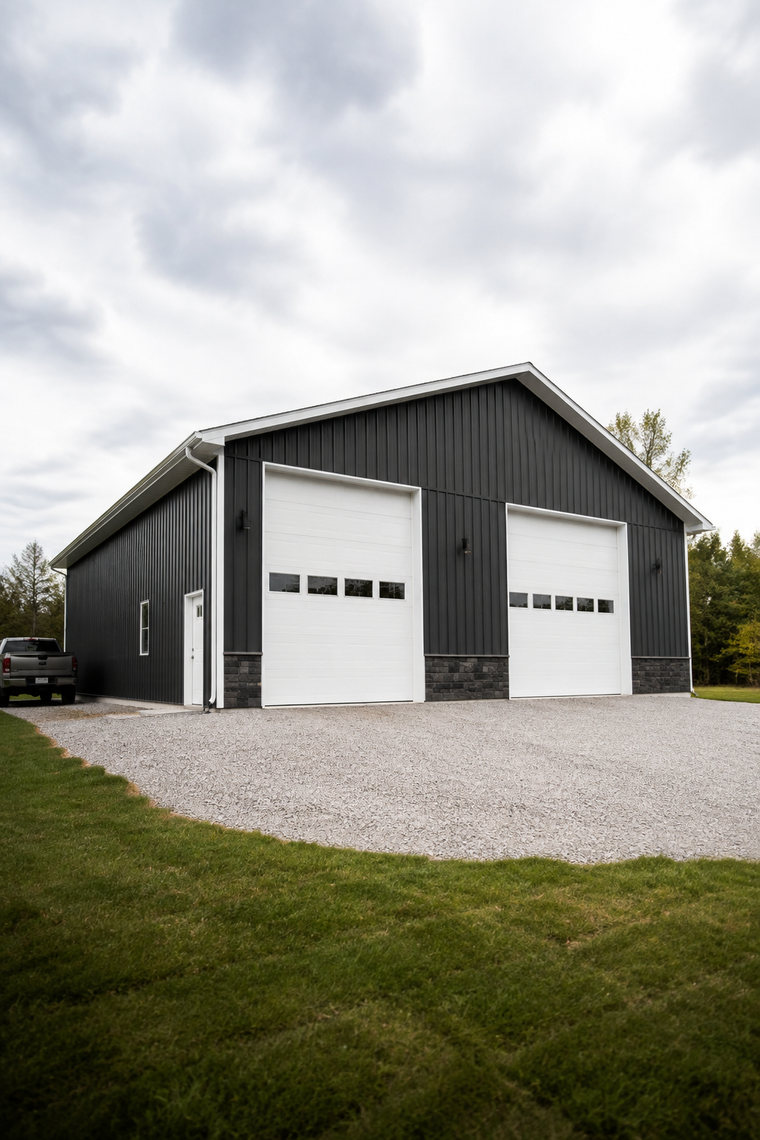
A 40x60 shop with 14-foot sidewalls goes up in an order the trade has settled: site prep, post set, girts and purlins, trusses, roof steel, wall steel, doors and windows, trim, slab. A generic list cannot be renamed into that. Framing is not one stage in post-frame; it is posts, then girts and purlins, then trusses, and each is a different day, often a different crew, and sometimes an inspection between them. Many jurisdictions inspect post embedment before backfill under their adopted edition of the International Building Code, so the boundary between Post Set and Girts and Purlins is a boundary an inspector also recognises.
The list also changes by building type. A hay barn has no slab and no interior. A barndominium has a slab, in-floor heat, interior framing, drywall and finish, and its stage list is twice the length. A riding arena has a footing stage nothing else needs. The software has to carry one list per building type, and a job has to be able to drop a stage that does not apply without the schedule reading it as skipped.
The crew lead does not want a stage called Framing on a Tuesday when his men are setting purlins. The stages on the job carry the names the trade uses, per building type, so the office and the field are reading the same word for the same work. It matters because the stage name is what gets stamped on every hour clocked, every photo taken and every customer update sent during it.
What moves a stage forward: the last tick, not a drag
A stage advances when its last checkpoint is ticked. Not when the office drags a bar, not when the planned end date passes. Every checkpoint before the last one is a quiet tick; the last one is different, because it finishes the stage and everything that hangs off finishing happens at once: the next stage becomes current, the customer's dashboard updates, and the people who should hear about it are told.
The crew lead on the roof is the person who knows Roof Steel is done; the office finds out by phone, hours later, or on Friday. When the last tick is made from the field it closes the stage for everyone, and it says so before it fires, so a man does not finish a stage by accident. The tick itself, who can make it and why the field only ticks forward is the subject of Stage checkpoints; what the customer sees the moment it lands is stage complete, one send, once.
The stage list is born at the counter-signature. The customer approves the estimate, fills in their details, and the agreement writes itself from the estimate, as contracts that write themselves describes. When you start the project, the building type on that contract decides which stage list the job gets. A stage was never typed for this job; it was inherited from the kind of building the customer signed for.
What a stage records that a calendar cannot
Every stage carries its planned length and its real one. When Trusses was figured for three working days and took five, that gap is a fact on the job, with the reason if somebody reported it: a blocked delivery, a wet week, a crane that did not turn up. Across twenty jobs the same fact answers the question you ask every January: which stages, on which building types, with which crews, run long.
You cannot price next year's labour off a memory of which jobs felt slow. Stage performance is built from the ticks, so the number is the crew's own record of when each stage started and finished. That is the return on making crews tick a list: the schedule estimate on the next barndominium is the last five barndominiums, not a guess.
A change order lives on a stage too. Add a 12-foot lean-to after signing and the days it adds land on Trusses and Roof Steel, not on a vague "schedule impact" note. The change order that protects margin covers the money side of that; the stage is where the days side goes.
Who stages are not for
A one-crew builder who finishes a shop in nine working days. The whole build is one stage as far as anyone needs to know, and the checklist is the job list on the dash of the truck. Stages earn their keep when two crews overlap on one site or one crew is on two sites in a week.
A job you are adopting mid-build. Stages are honest only if the ticks are real. Bringing a build in at Wall Steel with every earlier stage marked done by the office is a record nobody should trust. Adopt it at the state it is actually in and let the ticks start from there.
Check your current stage list in one minute
- Is there a stage called Post Set, or is it Foundation?
- Does a hay barn get a shorter list than a barndominium, or the same list with steps ignored?
- Is a stage's length counted in working days, so it does not run through a weekend?
- Does one crew own each stage, and can the crew lead see which stage is his next?
- When the last checkpoint is ticked, does anything happen, or does someone still have to drag a bar?
How the bars, the crews and the working days sit on one timeline is the build schedule contractor management software owes you; what happens when a stage has drifted out of order is why a shop reads 165 days, one check inside the Build Schedule. The board those stages live on, with the photos, the invoices and the crew payout on the same job, is Project Command. What a stage cannot do is protect a date from the weather; the construction schedule that survives contact with weather is a separate problem, and a delay recorded on a stage never moves your promised dates on its own.