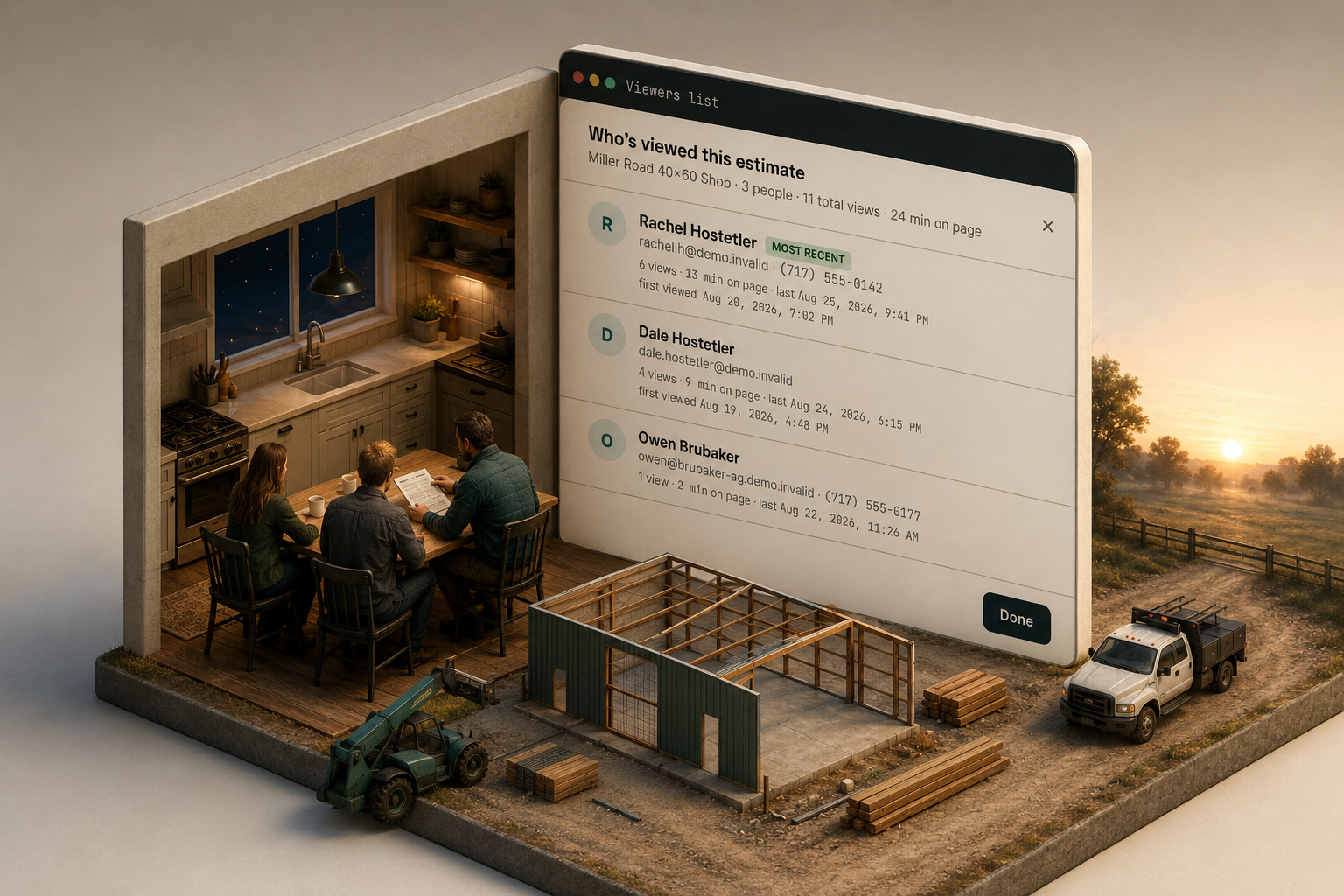
A customer who opens your estimate six times in four days is not ignoring you — more than one person is reading it, and they are stuck on a number. Estimate software for contractors should tell you that much: every open with a timestamp, how long the page stayed open, and which link it came through. A PDF attachment tells you none of it, which is why "three days of silence means they went with somebody else" is wrong more often than it is right.
What does view tracking on an estimate actually record?
Send the quote as a page instead of a file and the page can report back. It records every open with a time, roughly how long the page stayed open, which recipient link it came through when the husband, the wife and the lender each got their own, and how far down they got. It cannot name the person holding the phone, cannot tell you whether they are comparing you to another builder or to what a neighbour paid in 2021, and a forwarded link shows up as traffic, not as a new name. Email open pixels are weaker still: Apple Mail and Google's image proxy pre-fetch images, so a pixel "open" can be a machine. A page load with real dwell time is a person.
The pain is that the estimate is being argued over at kitchen tables you will never sit at. Estimate view tracking shows the argument happening: who opened the quote, and how many seconds they spent. Six minutes and four opens is a different phone call from nine seconds, and the call is the point of the data.
Which patterns are worth acting on?
Five show up over and over.
Six or more opens across several days, evenings and weekends is a pricing committee. Somebody in that house is stuck on the concrete allowance or the deposit, and the group will reach a decision without you unless you make its job easy. Do not send "just checking in." Send a one-page version of the scope, a plain sentence on what the deposit and draws look like, and an offer to spend fifteen minutes on the phone with everyone at once. If they are financing, the lender wants draws tied to milestones, not a lump sum.
One open, under a minute, never again is sticker shock. The instinct is to cut price. Cut scope instead and let them choose: pour the slab under a separate contract with their own concrete guy, drop from two 12x14 overhead doors to one, or set the lean-to posts now and sheet it next spring. Discounting teaches them your first price was soft; scope options teach them the price is a function of what they asked for — the same discipline that belongs in the proposal itself.
Zero opens after 72 hours is a delivery problem, not a rejection. It went to a shared inbox nobody watches, the address has a typo, or it tripped a filter. The fix is a channel change: text the link. Ninety seconds recovers a job you would otherwise write off. If you follow up in bulk by email, the FTC's CAN-SPAM guide is ten minutes well spent.
The pain behind a zero-open estimate is that you cannot tell a spam folder from a lost sale. Review and send reports a bounce instead of swallowing it, so a wrong address is something you fix the same afternoon rather than a silence you interpret for a week.
One long session of eight to twelve minutes, then quiet is a customer building a comparison. They are lining your lines up against another builder's, and the two documents almost never describe the same building. Send the assumptions: post size and embedment, truss span and spacing, girt and purlin spacing, panel gauge and warranty, what the concrete allowance covers, what is excluded. Most "you're higher than the other guy" conversations are scope mismatches — the trap covered in how to bid without guessing.
A re-open after three silent weeks is the highest-value alert you will get. The permit came through, the equipment loan closed, the other builder quoted a spring start. Call that day.
Where do the opens show up when you are working the job?
The pain is that you should not have to open the estimate to learn whether the customer did. On the contact record, every estimate sent to this person is listed with what became of it — Sent, Opened, Approved — with a version number where there is more than one, so the rep ringing them back knows whether they have read v3 before the conversation starts.
What follow-up sequence does not burn trust?
One rule keeps follow-up from feeling like pressure: every touch carries one new piece of information. If you have nothing new, you do not have a follow-up, you have a nag.
- Day 0. Send the link and text a one-liner so they know to look for it.
- Day 2, opened and quiet. One specific question tied to what they read: "Did you want the 12-foot lean-to priced open or enclosed?" A specific question gets answered; "any thoughts?" does not.
- Day 5, unopened. Change channel. Call.
- Day 8. New information: your supplier quote expiry, current steel lead time, where they sit in your build calendar.
- Day 14. Close the loop: "I'll take this off my active list so I stop bugging you — say the word and I'll bring it back and re-check pricing." People answer permission to stop.
- Then nothing until a re-open fires, which comes with a reason to call.
The pain is that the day-8 touch happens whenever the shop is slow, not on day 8. A reminder written from the thread — reply to their last message, call them, or check in if they have not replied — carries the contact with it, so the task opens back onto this conversation on the day it is due.
What this data cannot tell you
Tracking tells you attention happened; it never tells you why. Eleven minutes on your document might be a customer falling in love with the 16-foot walls or building the case against you for their spouse. The data narrows the question — it does not answer it — and any tool that says a job is "72% likely to close" is guessing with a straight face. What you get is a reason to pick up the phone at the right hour, which is most of the job. The estimate that reports back is one piece of the live estimate system; the quote your customer reads is where the opens come from, and an approval on that page — not a warm phone call — is what actually locks the price.