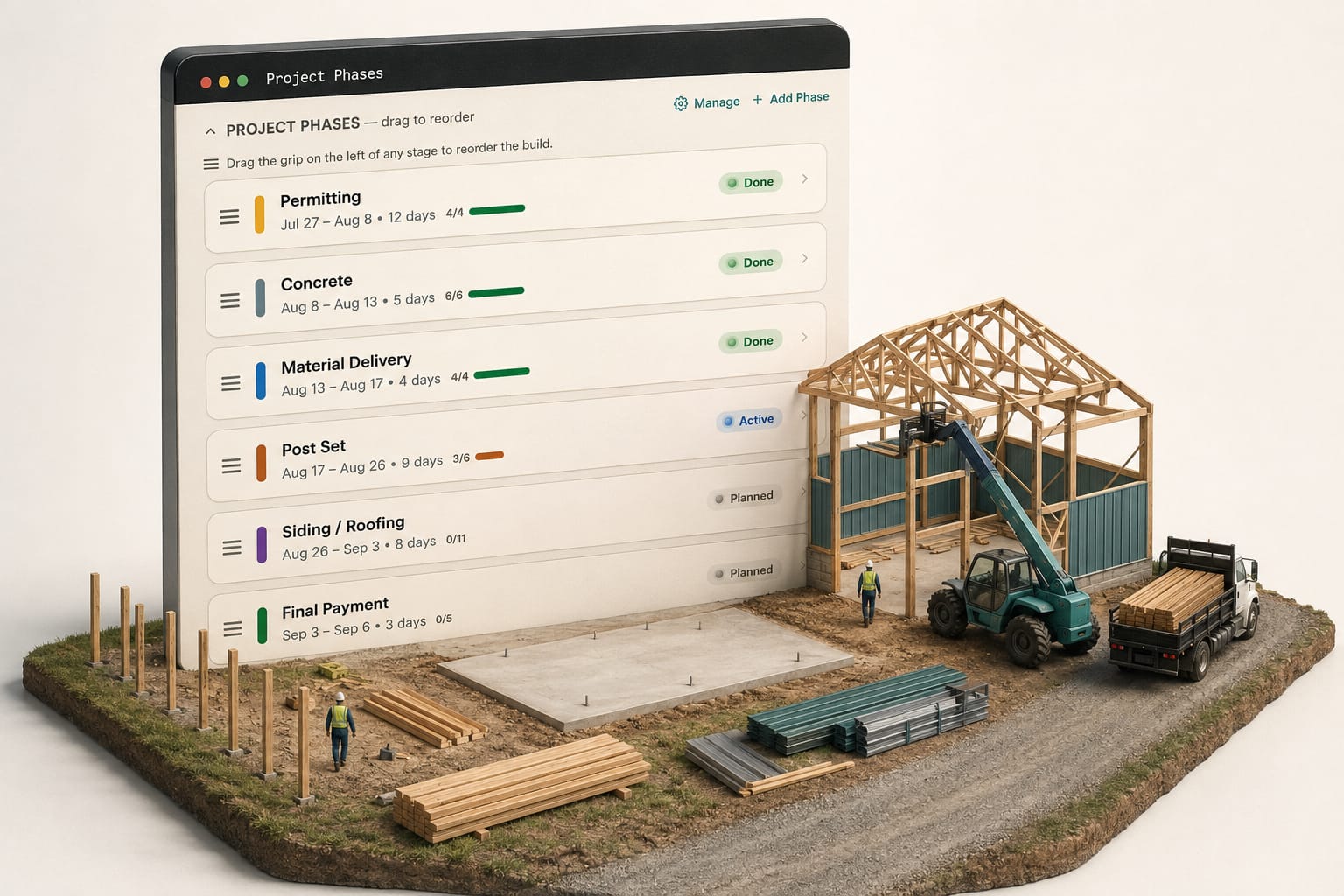
The short answer: Jobber for pole barn builders works well while your work looks like service visits: one trip, one price, one invoice. It starts to strain once a job becomes a project, with several design revisions before the sale, a deposit and stage draws, materials ordered weeks ahead and a crew schedule that runs for weeks. That is the point to look at project-shaped software.
Jobber is very good software. If you run a lawn crew, a plumbing outfit or an HVAC service business, it is close to the best answer on the market, and a lot of construction companies buy it for exactly that reason: it is clean, it is quick to set up, and the people who use it like it.
The question is not whether Jobber is good. It is whether the shape of your work matches the shape the software was built around — and for post-frame builders that is where it gets interesting.
What Jobber genuinely does well
Give credit where it belongs. Jobber's core loop is request, quote, job, invoice, and it runs that loop better than most.
- Scheduling a day of visits. Drag a job onto a calendar, dispatch it to a tech, see the route. This is legitimately excellent, and most construction software is worse at it.
- Quick quotes out the door. A two-line quote in ninety seconds, emailed, approved on a phone.
- Getting paid fast. Card on file, automatic follow-up, deposits. Their payments experience is better than a lot of purpose-built construction tools.
- Onboarding. You can be running by Friday. Nobody says that about most construction platforms.
If your business is one to three visits per customer and the money settles within a week of the work, that is the whole job, and Jobber does the whole job.
Service DNA and project DNA are different animals
The mismatch is not features. It is the unit of work.
Field-service software is organised around a visit: someone goes to an address on a date, does a thing, and it is finished. Construction software is organised around a project: one job runs for eleven weeks, has phases that depend on each other, gets billed in pieces before it is finished, and changes scope halfway through.
Six places builders feel that difference:
| What happens on a post-frame job | Where a visit-shaped tool strains |
|---|---|
| A 40x60 shop takes 9 weeks across 6 phases | The job is one card with one date |
| Concrete has to cure before posts get set | No dependency between one visit and the next |
| You bill 30% deposit, 40% at dry-in, 30% at completion | Invoicing assumes you bill when the work is done |
| The customer adds a 12-foot lean-to in week four | Change orders are a quote you email again |
| The lumber package lands three weeks before the crew | Materials are not on the timeline |
| A retainage clause holds 10% for 30 days | Not a concept the software has |
None of that is a criticism of Jobber. A service platform has no reason to model retainage — its customers do not have it.
Where builders feel it first
In practice it shows up in the same four places, roughly in this order.
Stages. A post-frame build is not one event. Site prep, concrete, posts and framing, roof and sheeting, doors and trim, final. Each has a different crew, a different material need, and a different definition of done. When the software has one status field, the answer to "where is the Hendricks job" is whatever the last person typed.
Draws. This is usually the one that forces the decision. A $96,000 building billed 30/40/30 is three invoices tied to construction milestones, not one invoice at the end. If your tool cannot represent "invoice this stage when it completes", somebody is doing it manually in QuickBooks, and that person eventually forgets — draws are the first thing construction invoicing software for builders has to handle that service billing does not.
Selections and changes. Scope moves on almost every job. The customer wants a bigger door, an extra window, a lean-to. What matters is not that you can send a revised quote — it is that the change lands on the contract, gets signed, and shows up in the total the customer already agreed to.
Contracts. A service business works off an accepted quote. A builder works off an agreement with payment terms, a lien notice where the state requires one, and a scope description precise enough to argue from later.
The graduation path
There is a fair way to think about this, and it is not "switch software".
Stay where you are if your average job is under two weeks, you bill once, and scope rarely moves. You do not have a project problem and a project tool will feel like paperwork.
Start looking when two of these are true: your average build runs longer than a month, you bill in draws, you are managing subs as well as your own crew, or somebody is maintaining a spreadsheet alongside the software to answer questions the software cannot. That last one is the real signal. The spreadsheet is the shape of the missing feature.
Then move once, at the start of a season, not mid-job. Migrations during a build are how you lose a draw.
The National Frame Building Association publishes good material on how post-frame projects are actually sequenced, which is worth reading before you evaluate any tool against your own process. On our side, the construction change order post covers the scope problem in detail, and how to bid a job without guessing covers the estimate that everything downstream depends on.
What that looks like on our side of the line: the building is designed before it is priced — drawn in 3D, with the material list coming off the model rather than a form — and the sale runs on one board where every lead sits until it is a contract, with the agreement written from the approved estimate instead of retyped from it. The nine weeks after that run on a build schedule the crew and the customer both see.
What the research says
- Jobber's own research shows where service businesses feel the load. In its 2026 Home Service Trends Report, a vendor survey of 1,050 US home-service owners, 31% named admin and paperwork and 28% named invoicing as their most time-consuming daily task. On a post-frame job that load multiplies, because one building carries a deposit, several draws and change orders instead of one bill.
- A post-frame sale is a design process before it is a job. Hansen Pole Buildings says its customers typically request 10 to 15 quotes before they settle the design (Hansen's own figure, not an industry number). Service software assumes one price per visit; a pole barn needs every version of the building kept, and the right one tied to the signed contract.
- Projects run longer than the plan because of how people forecast. In Buehler, Griffin and Ross's experiments, people underestimated their own completion times because they pictured the plan and ignored past experience, and the bias went away when they were told to connect the forecast to past jobs. A multi-week build needs a schedule that tracks stages against what really happened, which a visit calendar can't show.
- Construction money comes in stages. A lender's guide to construction loan draws describes 4 to 6 milestone draws on a typical residential loan, each released after an inspection. A financed barndominium runs on that rhythm, so billing has to follow the build, not the visit.
A one-minute check
- Write down your average job length in weeks. Under two, stop reading.
- Count the invoices on your last completed build. More than one means you bill in draws.
- Find the spreadsheet somebody keeps beside the software. Ask what question it answers.
- Ask who knows the current stage of every open job without opening anything. If nobody does, the status field is not doing its work.
- Check whether your last three change orders were signed or agreed verbally.
To see Jobber beside the other platforms builders shortlist, pole barn software, 17 platforms compared checks each one against the 128 things a post-frame or barndominium builder needs. The split runs through marketing software too: what a marketing CRM does for pole barn builders is the follow-up, not the 40x60 quote.
The honest limit: none of this tells you whether a change of software will actually get used. The most common failure is not picking the wrong tool — it is picking a better one and having three people carry on using the old process inside it. That is a management problem, and no vendor, us included, can solve it for you.