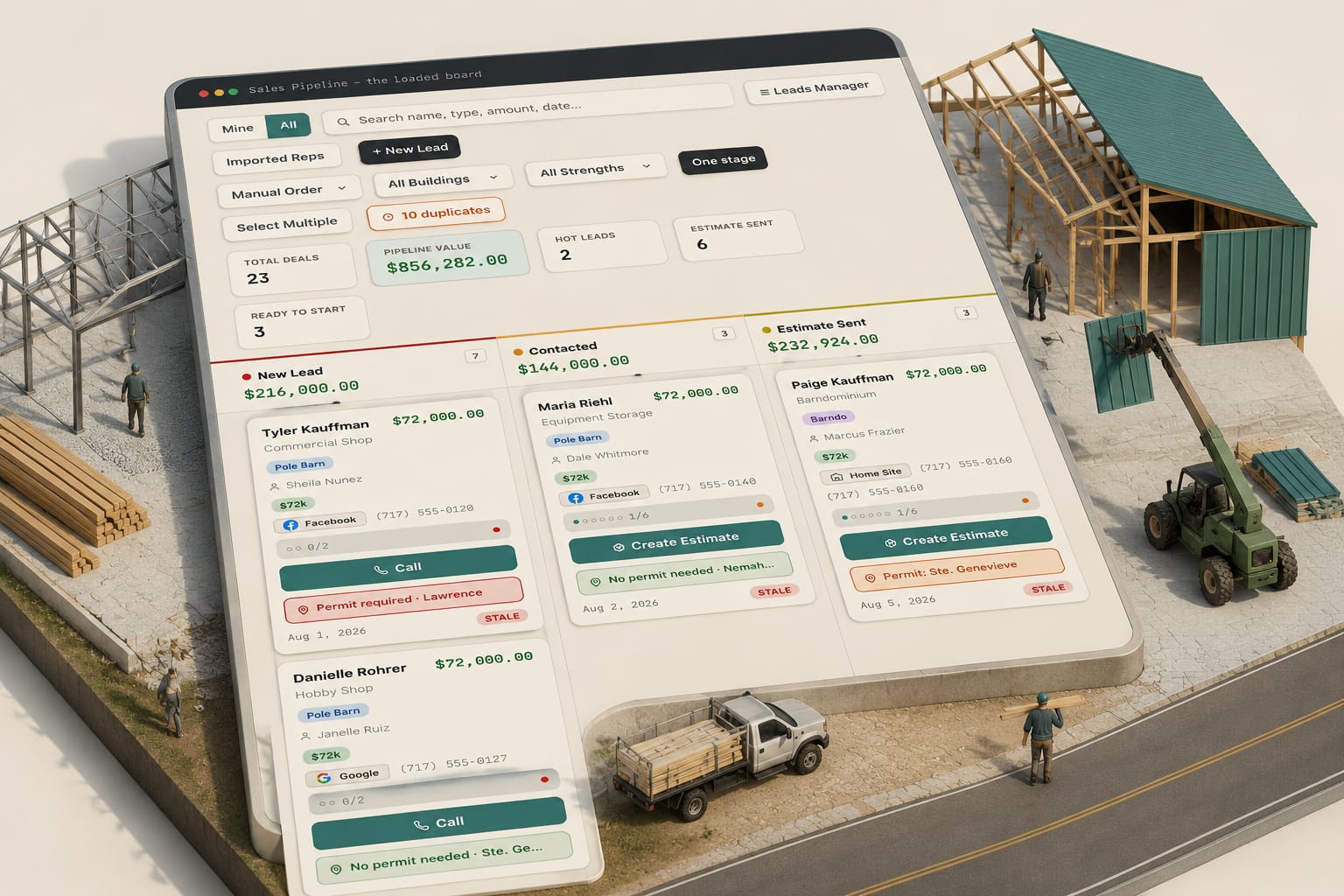
The short answer: Pole barn lead follow up works when it is a rule, not a memory: every lead sits in a stage, every stage has a next step with an owner and a date, and the follow-up call after an estimate goes out is set before the estimate leaves. Leads go cold in the days after the estimate, when nobody calls to ask what the customer thought, and a rule makes that day visible before it passes.
The lead did not die on the phone. It died on a Tuesday afternoon, three days after the quote went out, when nobody called to ask what the customer thought. By the time someone remembered, he had signed with the builder who did.
Leads go cold in a post-frame company for one reason, and it is not price. Lead follow-up is a memory instead of a rule. A lead sits in someone's head, or in a notes app, or on a quote sheet in the truck, and heads, apps and trucks do not ring on the ninth day. A post frame builder CRM exists to turn that memory into a stage with an exit condition, so the ninth day is visible before it happens.
Look at the board on a Monday
Tyler Kauffman asked about a commercial shop from a Facebook ad on August 1. Nobody has called him. His card is still in New Lead, marked stale, with the two required steps unticked. That is the pain: a lead nobody decided to ignore, ignored anyway. The Sales Pipeline Board puts him in a column with a value and a count, beside every other job at the same stage, so the untouched card is the first thing an owner sees on Monday. It works because the unit is the stage, not the contact: a list of names says who; a board of stages says whose move it is.
Where the nine days went
Leah Beiler got her estimate on August 11 and has heard nothing since: nine days and four hours in Estimate Sent. The lead timeline shows the stage that ate the days and the one step nobody ticked, "Decision follow-up". Dwell per stage is the honest measure of follow-up; a total age hides where the days went.
Why "we'll remember" cannot work at this volume
The arithmetic is unforgiving. A shop taking twelve enquiries a month has thirty to forty leads somewhere between first call and signed contract at any moment, each needing a next action on a date. Nobody carries forty dates in their head, and the ones that fall out are always the quiet customers, the ones who did not call twice.
Speed matters as much as persistence. Harvard Business Review's study of online sales leads found that most companies respond far too slowly to inquiries, and that the odds of reaching a lead fall sharply with every hour that passes. For a post-frame customer who filled in a form on a Sunday night, the builder who calls Monday at eight has the conversation; the one who calls Wednesday gets voicemail.
The call that was never returned
There is a second way leads go cold, and it is quieter. The customer calls, nobody picks up, and the missed call becomes a notification that scrolls off the screen by lunch. No lead card, no task, no record that it ever rang.
The fix for that is not a better phone. It is a rule that a missed call always creates something a human will see and has to clear.
What actually removes it
Three things, and none of them is discipline.
A stage with an exit condition. A lead cannot leave Estimate Sent until the decision follow-up is done. The rule does the remembering.
Age on the card. A lead that has sat past its stage's normal dwell time changes colour on the board. Nine days in Estimate Sent is a red card, not a memory.
A missed call that becomes a task. Every unanswered ring lands on a callback list with the caller's name and the time. The list is empty only when the calls are made.
Those three rules are what the Sales Pipeline Board is built around, and missed call rescue is the third one on its own. How they work stage by stage is those pages' job. This post's job was the diagnosis.
A post frame CRM exists for exactly this: it holds the building they want, the county it sits in and how long they have waited for a call, from the first ring to the signed contract. Builders who started on a roofing CRM find its stages shaped for a one-day tear-off; a JobNimbus alternative for post frame builders has to carry nine weeks.
What the research says
- Plans tied to a trigger run themselves. Gollwitzer's review of implementation intentions shows that if-then plans ("when situation X arises, I will do Y") hand control of the behavior to the cue, and reliably beat plain good intentions. "When an estimate goes out, a call is set for day three" is an implementation intention for the whole office, not just the person who remembers.
- Specific beats vague. In Milkman and colleagues' field experiment, people prompted to write down the date and time they would get a flu shot raised vaccination 4.2 points over a 33.1% baseline, while writing only a date made no significant difference. A follow-up task with an owner and a time gets done in a way that "follow up next week" does not.
- Customers judge you on whether you do what you said. In a Consumer Reports survey of 913 homeowners, failing to show up was the number one gripe about contractors, and cost overruns ranked lowest. That is remodeling, not new buildings, but a follow-up call that was promised and never came lands the same way with a pole barn customer.
- Buyers are coached to drop slow builders. The kit seller's blog "Do You Speak Contractor?" tells pole building buyers that a contractor who doesn't call back is "just not into you" and not worth chasing. A customer who hears nothing after the estimate doesn't read it as busy; he reads it as an answer.
Before you fix follow-up, check the top of the funnel
If the board is not full, the problem is upstream. Where post-frame leads actually come from is the read for that week. And if leads are closing but the quotes take a day each, the constraint is estimating, which the builder's short list of estimating software covers.
But if you have ever opened a truck door and found a quote sheet from a customer you meant to call, this was the problem. Nine days is not a customer changing their mind. It is a follow-up nobody made, and the fix is a stage that will not let it be forgotten.